Chukwudubem Ukaigwe at Catriona Jeffries, Vancouver
By Ogheneofegor Obuwoma
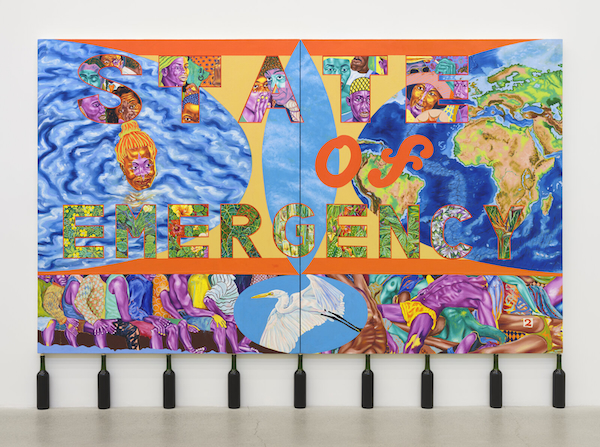
Chukwudubem Ukaigwe, Tree! You Can Be a Canoe! Unless you Cannot! (Named for Walcott), 2024, oil on canvas, nine bottles of artist-brewed wine (Alicante), diptych (photo: Rachel Topham Photography)
Chukwudubem Ukaigwe‘s solo exhibition Another Octave Higher begins with a sonic collection of paintings that explore the intimacies of Black life through complex visual encounters reflected in meticulous layers of paint and world-building. His work references conversations within Black studies, drawing on thinkers such as Sylvia Wynter, Rinaldo Walcott, Christina Sharpe, and Dionne Brand. Through this lens and research, Ukaigwe examines the realities of Black life shaped by the intricacies of diaspora. His paintings invite viewers to participate through different, often spatial and lyrical, “exercises”. Throughout my visit to Catriona Jeffries, I was compelled to engage closely with each work, to move in and discover words or unfinished paint marks that complicated my reading.
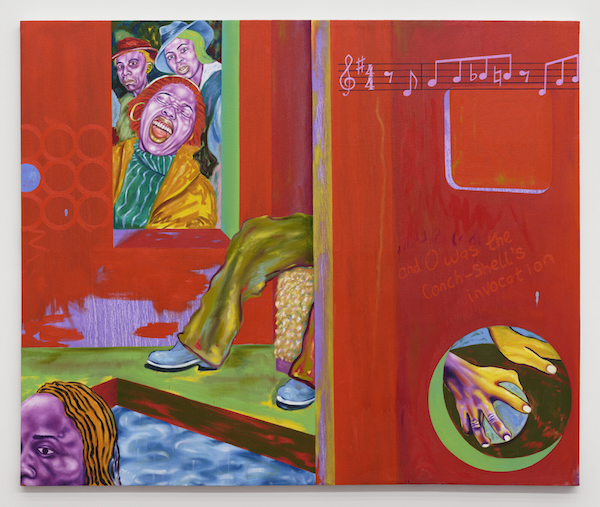
Chukwudubem Ukaigwe, B# is C / Jump Punk Monk, 2026, oil on canvas (photo: Rachel Topham Photography)
I was first drawn to how Ukaigwe explores the complex relationship between figuration and abstraction through experimenting with motifs and frames within the canvas. Tree! You Can Be a Canoe! Unless you Cannot! (Named for Walcott) (2024) stood out in many ways. It was hung low, above nine bottles of wine brewed and bottled by the artist. The words “State of Emergency” appear at the centre of the painting, set against symbolic images of the natural world. These words act as a recognizable call to action, while the depicted bodies and geography reference harrowing comparative conditions of the transatlantic slave trade and the dangers that African migrant’s face today on their sojourn towards “a better life” in the West. Ukaigwe engages these histories and their reverberations in the present condition of Blackness to critique society’s complacency towards historical and political events. He represents Blackness on canvas with intimacy and care. He visually shields the body when needed, interrupting the viewer’s gaze, and allows some figures in the paintings to stare back or suggest that a song might break out of the frame, as seen in B# is C / Jump Punk Monk (2026).
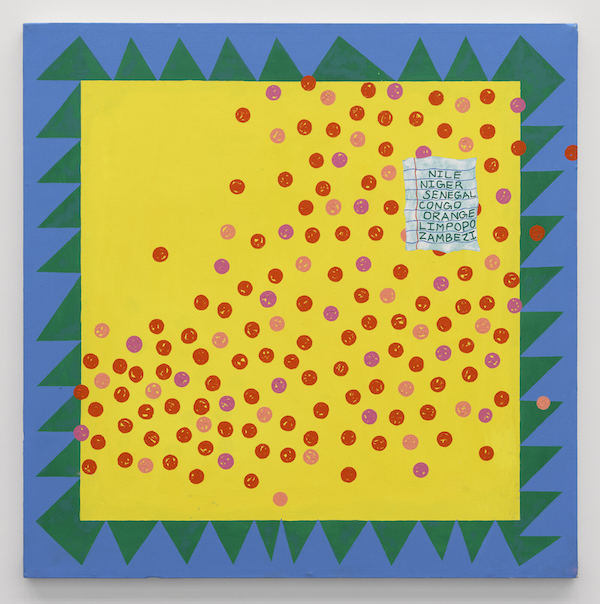
Chukwudubem Ukaigwe, Speaks of Rivers (Titled after Hughes), 2024, oil on canvas (photo: Rachel Topham Photography)
I found myself caught between unexpected stagings and what felt familiar. As I examined each work to understand its composition, I noticed that scenes were often flipped or reframed through these somewhat cinematic gestures, and a halting use of language that left traces across multiple paintings. Words left in pencil could also reappear in paint elsewhere. The traces across the paintings create an interconnected world with multiple reference points and stagings that demonstrated an interesting sense of continuity. Although the exhibition featured mostly recent work, Ukaigwe’s older paintings maintained this visual cohesion that evokes a referential, storytelling impulse. They offer many entry points, shaped by positionality, as painted words or scenes may appeal to each viewer differently. Ultimately, his investment in Blackness brings me closer to each painting as I search for answers, fragments, and relational throughlines. I do not always see an abstract location; instead, I see a painted padlock as an intimate encounter, and view Speaks of Rivers (Titled after Hughes) (2024) as echoing a primary school rhyme from Nigeria. The artist creates these slippages, letting various scenes reach viewers in personal ways.
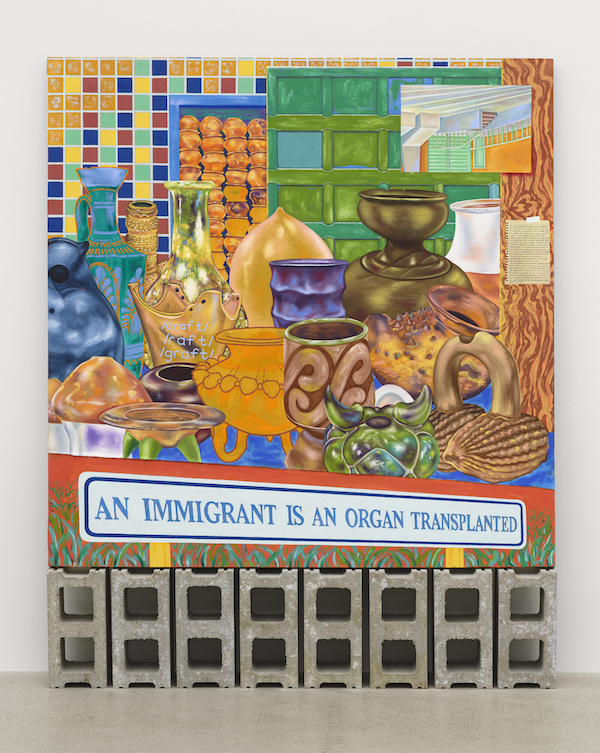
Chukwudubem Ukaigwe, The Story repeats itself syncretized and Variegated, 2025, oil on canvas, eight cinderblock bricks (photo: Rachel Topham Photography)
In The Story repeats itself syncretized and Variegated (2025), Ukaigwe cohesively brings together some of the exhibition’s key explorations. He creates his paintings through in-depth world-building and sonic and theoretical research. This one inquires into the semiotics of diasporic belonging by challenging the state while forming language shaped through the intimacy of community. It raises questions about the relationship between a transplanted organ’s refusal and a state-sanctioned refusal of a transplanted person. The land of origin is complicated; the ceramic vessel, which is repeated across multiple paintings, might signify a journey or a forced exit. The shekere percussion instruments painted at the edge of a canvas suggest possible sounds and feelings held in that space. These stagings speak to the possibility of making something familiar and intimate from the depth of diasporic language and belonging.
Chukwudubem Ukaigwe: Another Octave Higher continues until May 9.
Catriona Jeffries: https://catrionajeffries.com/
The gallery is accessible.
Ogheneofegor Obuwoma is a Nigerian filmmaker, storyteller, and artist with a BFA in film and communications from Simon Fraser University. Her work explores “the personal” in relationship to her larger community and the cultural experience of being Nigerian. She is interested in African futurism and the ways we access the spirit.