Cathy Busby on Art, Care, and Dementia
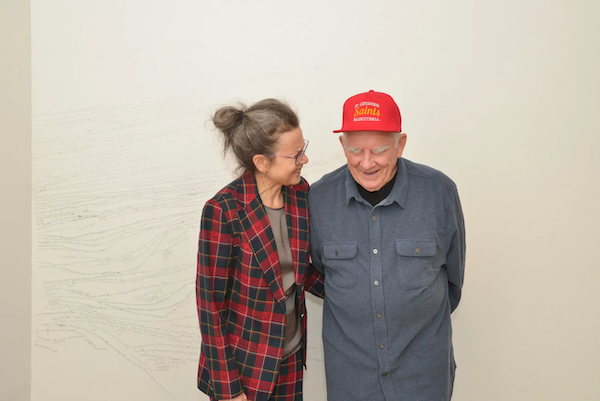
Cathy Busby and Garry Neill Kennedy in front of his installation Remembering Names, 2018, writing in pencil on wall, CSA Space, Vancouver (photo: Alisha Weng)
Cathy Busby’s 2025 book I WONDER: Art+Care+Dementia documents her experience caring for and collaborating with her late husband, artist Garry Neill Kennedy, in the years prior to his death. Akimblog recently spoke with her about the projects they worked on, maintaining dignity at the end of life, and creative dementia care.
Garry used to say sometimes, like a cheery expression, he’d just say, “Oh, I wonder…” I didn’t think anything of it really. And then, as his cognitive capacities declined, it was something that stuck with him. There were lots of other things that he just couldn’t say anymore, so it’s not that he said it often, but it stood out when he said it.
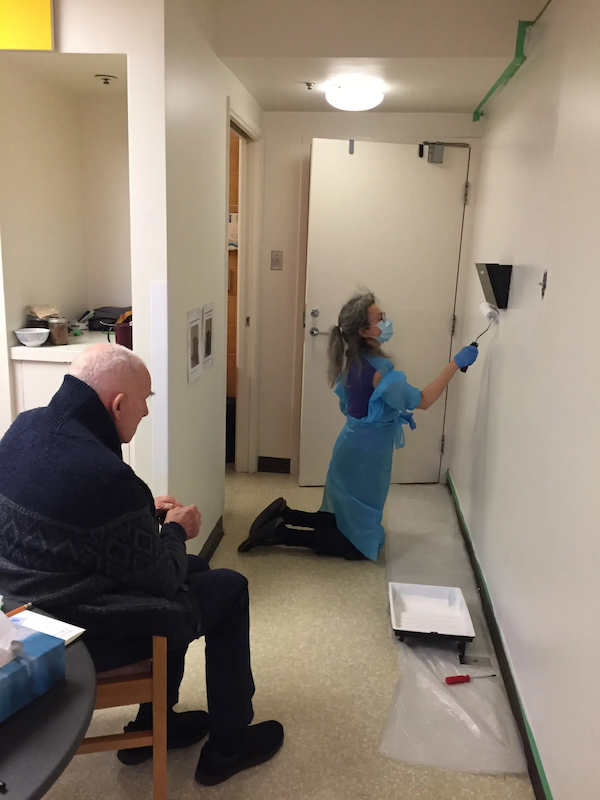
Quarantine Countdown in Garry’s room at Louie Brier care facility, mid-installation view, wall-re-painting, permanent installation, Louie Brier Home & Hospital, Vancouver, March 2021
When he was in his first long term care facility, I made a quarantine countdown clock where I measured the circumference of the room and divided it into fourteen because he had to stay in the room for fourteen days. It was during COVID – a horrible time for Garry, who, even in his older age, needed to move around. It kept us busy because every day I came in and I would paint, and he would watch, he’d sort of supervise. It really helped us get through that time because we had a project every day. I did 1/14 of the room, which was about five feet in width, each day. I had to tape it off. It was a conceptual art project with all those familiar things for Garry. He would hold the level or the pencil, and I’d say, “Garry, can you hand me the pencil?” And he could. These were things he could do when his language was pretty absent. That was one precursor to the I WONDER project. The groundwork was laid to be able to make art in long term care. I figured if I could do it in one place, I could do it in another.
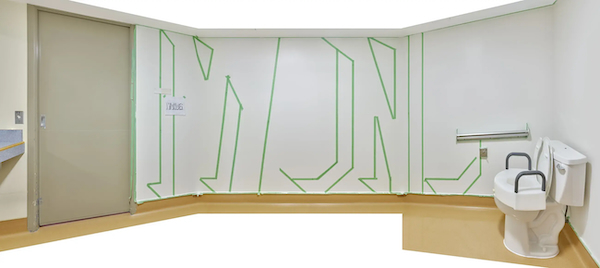
I WONDER in the bathroom of Garry’s last care facility, mid-installation view, wall-text painting, partially completed installation, Parkview Care Facility, Vancouver, July 2021 (photo: Rachel Topham)
In the second long term care place, he had a large bathroom, but the walls were quite damaged from wheelchairs hitting the drywall and denting it. I thought it would be a nice project to fix up the bathroom and then do a painting. I got permission and started patching up the walls and painted a base coat the color of our condo, which is what I did at the other care facility too. It’s called Snowbound White in Sherwin Williams nomenclature. Then I started taping out the letters. I was copying Garry’s superstar shadow font, which he’d used in many wall text paintings. I did my best to copy it, which was okay, but it wasn’t stellar. Then again, it wasn’t Garry’s painting. It was mine, right? It was my painting to soothe him. It took a while to patch up the walls and get two coats of paint on. I was taping and his health was rapidly declining. Then the doctor told me he probably had a week or two to live. I was shocked, but not deeply surprised. I knew he was on the way down, but I didn’t think it would be that fast. He ended up passing away when I was starting on the D, which was perfect for Garry because he had quite a competitive streak, and it was comforting for me too. I hadn’t been able to finish, but at least it said, “I won.”
I feel like I was adapting and watching how Garry could adapt in those projects. It was a gathering together of how we’d worked and an adaptation of that to the given circumstances. Part of the purpose to it was to maintain Garry’s dignity. In long term care, everything gets stripped away and you’re not this full, wholesome being who’s lived and done things in the world all their life. All those things you could perhaps still lean on. I was helping Garry to lean on those things, because he’s an artist. He’s a conceptual artist. I made sure that there was good, strong Garry art in his rooms. It was part of maintaining his dignity to communicate this to the people who were looking after him – care aides, personal support workers, nurses, doctors – that he had had a big life, so please treat him with respect. I’d make a point of having conversations with people that were not just about when Garry was going to have his shower or if he had enough clean clothes and that kind of stuff. They were about him and his life.
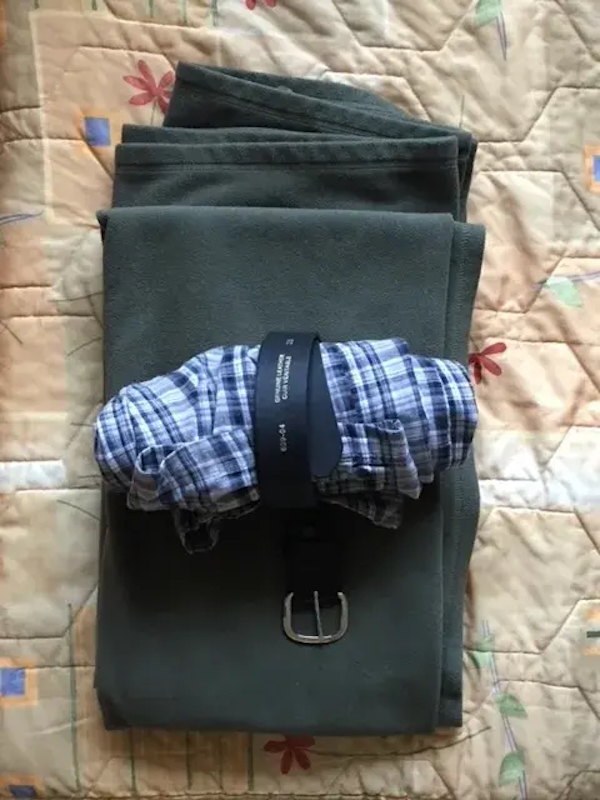
Garry Neill Kennedy, Arrangement, 2021, pyjama bottom with belt on folded throw (photo: Cathy Busby)
Another aspect of care is close observation. I used my phone camera a lot. Garry was always a guy who dressed well. He wasn’t a fancy dresser, but he liked his clothes. One day I came into the room and he had folded his pyjama bottoms like you’d fold a towel, and wrapped his belt around them. They were like a little bundle and on the top was the belt buckle in reverse so that the gold lettering was visible. It said genuine leather. I just thought, “This is Garry making a little installation here.” We’d been told he couldn’t wear belts anymore. For a man who grew up in the fifties, it was like he wasn’t dressed if he didn’t have a belt on. He’d taken the belt out of the closet and was making this statement. He wasn’t verbal then, but he made this little statement: he likes his belt. I have a section in the I WONDER book called Arrangements, which documents where he put things in a certain order in a certain way. I took pictures of them. If I hadn’t been observing closely, someone else might not have even noticed, but I was like, “Oh, look what Garry’s done.” This is about being artists. Artist caregivers with artists who are experiencers of dementia can do interesting things. I feel like we had an influence on the people who were the regular caregivers. They could see we were doing things differently.
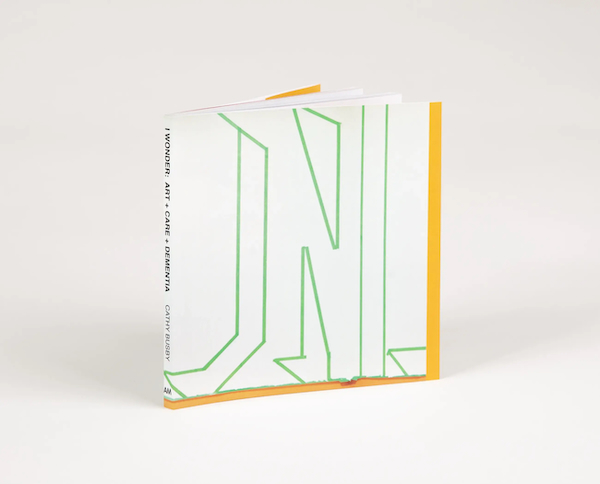
Cathy Busby, I WONDER: Art+Care+Dementia, 2025, artist book, Art Metropole, Toronto (photo: Charlie Mahoney-Volk)
It really helped me to not feel guilty when Garry died. I felt like I had done everything my being could do, that I had called on all my resources – my administrative smarts, my creative smarts, my communication smarts, my community building smarts. I pulled on everything to make this as much as I could a part of life in an enlivened way – not like this horrible thing we were going through. I mean, it was a horrible thing, but it was lots of other things too. It was access to this other worldview, another sense of time, another sense of language. So it was enriching. I can say that now, even as I would never have wished for it. Taking it on as a creative challenge made a huge difference. I see it as a chapter in our lives. Not a dead zone or something when I lost all that time. No, it was rich.