Canadian Art Hop in London, ON
By Kim Neudorf
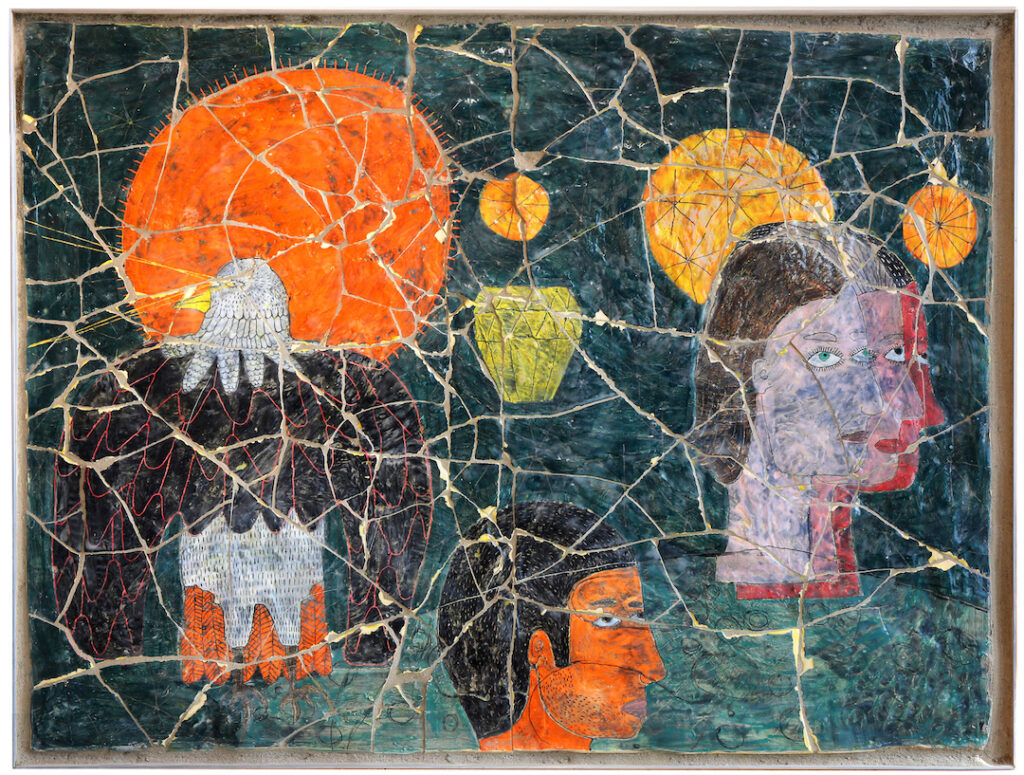
Susan Day, Folklore, 2026, glazed stoneware on panel (courtesy: Michael Gibson Gallery)
My first stop on our local contribution to the 2026 Canadian Art Hop is to see Emelie Robertson’s new paintings at Michael Gibson Gallery. Robertson, a recent MFA grad at Western, visualizes “place through memory” by using highly responsive processes such as oil on Yupo paper. A large-scale painting shown previously at the university as an interactive installation makes it clear that Robertson’s improvised material decisions continue to thwart relegation to mere surface appeal or a generalized idea of landscape. Also on display, Susan Day’s drawings and paintings on supports such as old maps and ceramic fragments similarly focus on visual improvisation within the material constraints of each unusual ground.
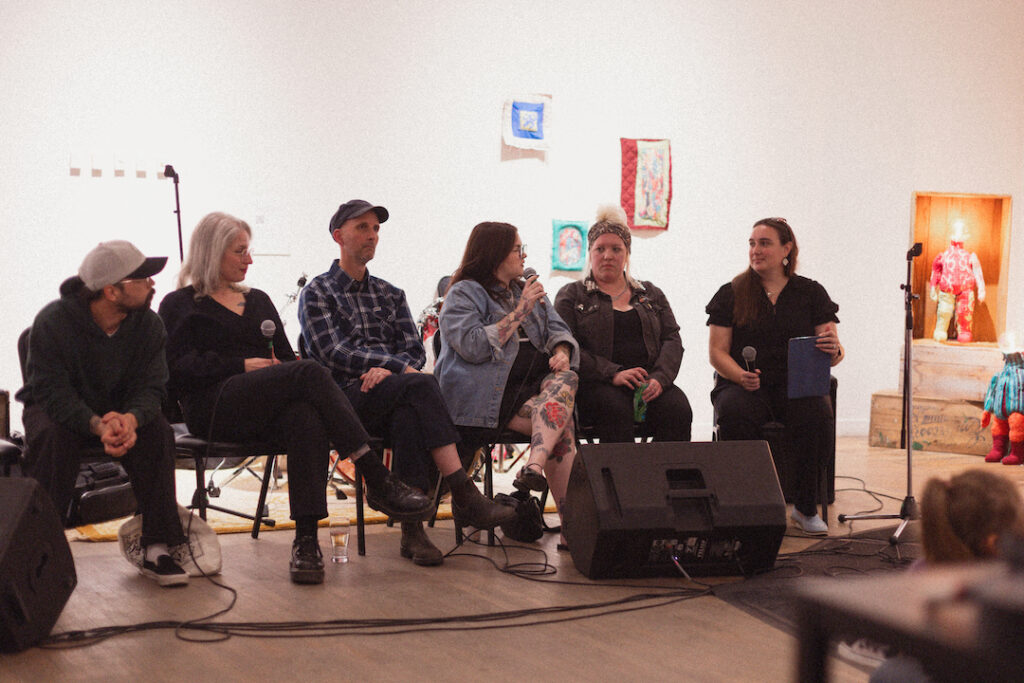
Punk Rock Flea Fest panelists from left to right: Alex Hann, Julie Kortekaas, Jeremy Bruneel, Alayna Hyrklic, Shayna Patterson, Erin Briggs (photo: Natali Bravo, Bravo Foto)
Overlapping with artist talks that night by Robertson and Day at Michael Gibson, Punk Rock Flea Fest began its three-day multi-event festival with its first artist and contributor panel at TAP, featuring an archive of PRFM poster art by artist Jeremy Bruneel and a Q&A with Bruneel, artist Alex Hann, PRFM booker and artist Julie Kortekaas, and PRFM co-organizers and artists Alayna Hyrklic and Shayna Patterson. Moderated by Erin Briggs and accompanied by the nearby buzzing of live tattooing by Victory Tattoo, the panel’s crowd was noticeably larger and more intergenerational than those attending many of the other Art Hop events. The panel focused on PRFM’s decade-long history of events, markets, and collaborations, as well as its various origin stories. Panelists spoke of the festival’s strong collaborative and local-business-oriented ethos, event accessibility, its benchmark of having at least fifty percent women and gender-expansive artists and performers, as well as the shared vulnerability, mutual support, and risk-taking made possible by PRFM’s many collaborators and volunteers. Information about the festival’s full line-up of performers, market vendors, and collaborators – including performances by La Rent, Ruby Doom, and Maux Marquis, which followed the panel – can be found at PRFM London’s website and Instagram.
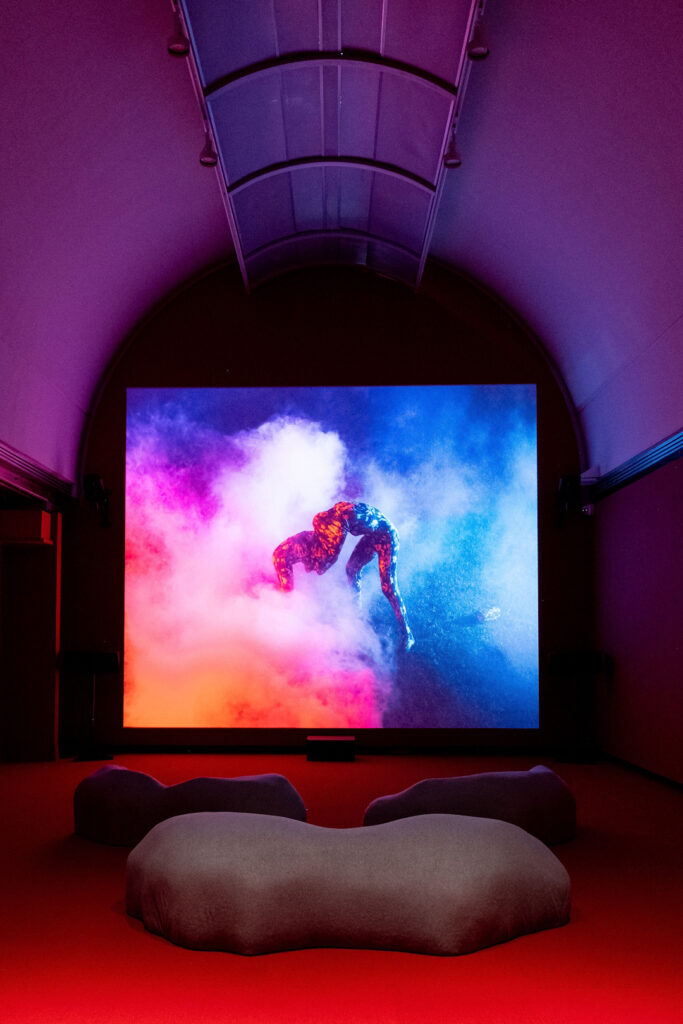
Dominique Rey, MOTHERGROUND, 2024, video installation (photo: Jamal Guzlan)
My next Hop stop was Dominique Rey’s MOTHERGROUND, in its last weeks at Museum London, which features photographs, sculpture, and video work either in collaboration with or inspired by the artist’s young children. In photographs and sculpture, the language of collage is used to refer to the often interchangeable, permeable boundaries between autonomous self, self-as-parent, and artist-as-parent. To maintain some level of privacy, the artist and her family are either shown in fragments or partially camouflaged in various textures and patterns. Seen through costume and collage, Rey and her family are layered, obscured, or subtracted (depicted in black and white silhouettes), flipping between abstraction and a kind of representational shorthand, inviting audiences to relate more generally. In a large-scale, multi-channel video – installed inside a cave/womb-like space – the artist and her children maneuver through the physical constraints of shared costumes and precarious body-piles. With a pervasive score composed by Patrick Kirst, the artist’s imposed formal flourishes (such as the use of slow-motion and smoke machine effects) override brief instances of messy improvisation within a choreographed sense of play.
My last stop was to check out participatory works by Jennifer Marman and Daniel Borins at McIntosh Gallery. Borins and Marman’s broad themes of resource extraction and data-mining are linked to an invitation to construct and remix abstract forms via a large “claw crane machine,” viewer-responsive headset, and video screen. In the exhibition text, an anticipatory description of producing “an unstable structure of control, chance, and authorship” results in skillfully devised, yet highly controlled “chance” outcomes. Which is, in a way, not unlike the Art Hop itself.
Emelie Robertson: Phase Dance & Susan Day: Electric Storms continue to October 31.
Michael Gibson Gallery: www.gibsongallery.com
The gallery is partially accessible.
Punk Rock Flea Market London
TAP Centre for Creativity: www.tapcreativity.org
The gallery is accessible.
Dominique Rey with Madeleine & Auguste Coar: MOTHERGROUND continues to October 11.
Museum London: museumlondon.ca
The museum is accessible.
Jennifer Marman and Daniel Borins: Three Dimensions continues to December 5.
McIntosh Gallery: mcintoshgallery.ca
The gallery is not accessible.
Kim Neudorf is an artist and writer based in London (ON). His work has appeared most recently at the plumb, Toronto; The Next Contemporary, Toronto; Harkawik, New York; Embassy Cultural House, London, ON; Support project space, London, ON; DNA Gallery, London, ON; Paul Petro, Toronto; Franz Kaka, Toronto; Forest City Gallery, London, ON; Modern Fuel Artist-Run Centre, Kingston; Evans Contemporary Gallery, Peterborough; and Susan Hobbs Gallery, Toronto.