AO Roberts on PPE
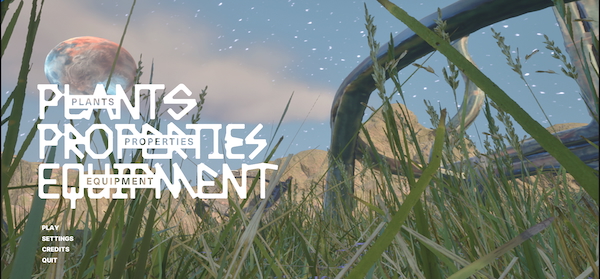
Plants Properties Equipment virtual world menu
AO Roberts is a multidisciplinary artist, musician, writer, and curator based in Treaty 1 territory, Winnipeg. They recently released Plants Properties Equipment, a virtual world and soundtrack album featuring collaborations with five other Deaf and Disabled artists. Akimblog spoke with them about the genesis of this project.
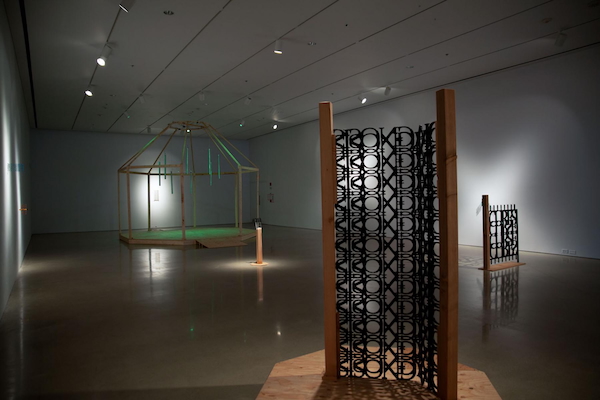
AO Roberts, Sickroom, 2022, installation view at University of Manitoba School of Art Gallery
The last big body of work I made before releasing Plants Properties Equipment was called Sickroom. It was about my own experience with illness and disability, but also how we navigate systems like health care systems and how that’s an architectural problem in some senses as much as it is a philosophical and emotional problem. It was launched in January 2022 – the peak of the lockdown – so it felt like the culmination of my own thinking around disability and also everything that was going on around me. People could only see it by appointment, so it wasn’t seen as much as it could have been, but it helped me grow that part of what I’m doing to think about access aesthetics in the way the work was presented. That really fed into this new project.
One work in the exhibition was called Cures Curse and it was a specific reference to Eli Clare’s book Brilliant Imperfection, which is all about ideas of cure when it comes to chronic illness and disability, and all the tensions that are there. People in the chronic illness community search for a cure and spend a lot of time sharing about the pain and struggle of living with illness. In the disability community, oftentimes we don’t have a cure and there’s never going to be one. My embodiment spans both of those. That place of contradiction is where I find the most exciting things with art. It’s also one of the hardest places to embody when you’re talking about highly politicized and embodied things that we all experience in the disability community in totally different ways. Each of us has a distinct story and experience.
Plants Properties Equipment screenshot
Plants Properties Equipment came out of the Sickroom project. I was doing a lot of voiceover stuff at the time, working on the audio descriptions for Sickroom and then looking at people like Finnegan Shannon‘s work and their alt text as poetry. I was inspired about using that as a central organizing force rather than an add-on afterwards. I wanted to build a world to think about all the stuff that I was thinking about, but start with sound instead of just describing this world after.
I was studying medicinal plant properties and thinking about our health systems as being so removed from our environment, and traditional medicines and Indigenous wisdom – all these different medical cosmologies that we’ve had and we still have access to, but are suppressed or not accessible. I thought an easy way to start with that would be to study one plant for a period of time and think about its nature and think, “If it had a voice, what would it be?” I wrote scripts and got voice actors to record the scripts, and then made sculptures based on that. I was thinking a lot about these plants. They have magical capabilities to affect us in ways that we don’t really understand. I thought of them as cosmic emissaries here to teach us something that we don’t have the ability to comprehend or we’re not listening. That led into more thinking about crip futurism. That’s where Plants Properties Equipment came from.
Plants Properties Equipment screenshot
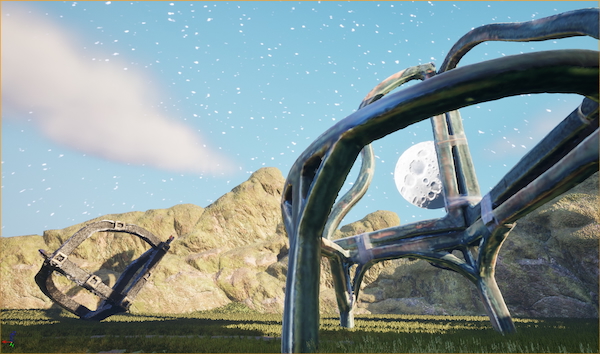
I wanted the project to exist across platforms. I wanted it to be installation and maybe online or in an app or something, so it could be accessed in as many ways as possible. I asked Leanne Lan Road in the Séance Collective for a meeting to learn about what I would need to do. They are a video game developer collective and they offered to develop it in collaboration with me. They really helped me, as someone who has no knowledge of this world, how to form the space and how to guide people through it. Originally, I thought it was going to be an open world that would allow people to move in between these sculptures I was working on, these triangular shapes that could function as monoliths in the space, even though in real life they’re just desktop sculptures. I wanted them to live as massive architectural things. I see them each as different speculative cosmologies, different worlds that we could live in, different medical systems that we could live in. I got excited about people being able to jump around on them and play within them. As we were building it and placing these sculptures within kind of grassland space, I worked with them to figure out how to move people through the space. It came to be about inhabiting the logic of video games, which is the sort of X and Y logic to get people to make choices.
Plants Properties Equipment screenshot
At the same time I wanted to develop more community within disability sound arts. Sound art and experimental music is already kind of niche, so finding the disability community within that is pretty difficult. It was exciting to reach out internationally to meet people and make our own community even within this small realm. That’s who the artists are that appear in the game and on the album.
Molly Joyce is a composer and musician based in Pittsburgh. She plays the toy piano mostly, but composes her music and does a lot of collaborations and disability activism as well within the new music and composition world. Andy Slater is a blind sound artist from Chicago. Chisato Minamimura from the UK is a deaf performance artist. Her piece is a performance of John Cage’s 4’33” in which she disassembles a piano and explores it with her body. Johanna Hedva is from LA but lives in Berlin, and they are a writer and also a musician. The last collaborator is Medical Museum, who are a new duo that formed for this project. They’re from the UK, from Leeds, and it’s Hang Linton and Laura Lulika. Laura’s a disabled visual artist and access consultant. And Hang is a musician and artist. And then there’s me. I have a solo project called Vor and I did the sound design for PPE.
Plants Properties Equipment screenshot
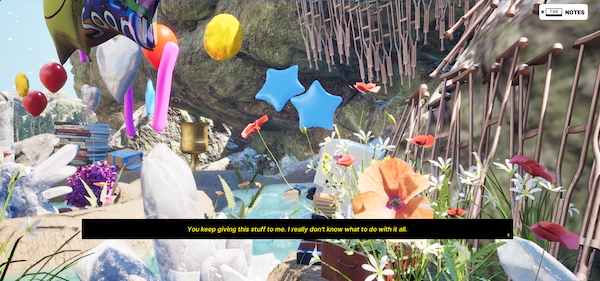
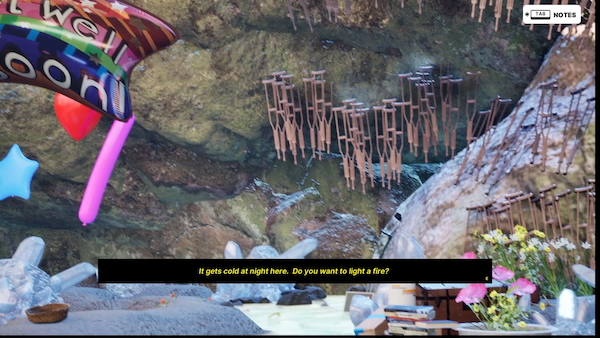
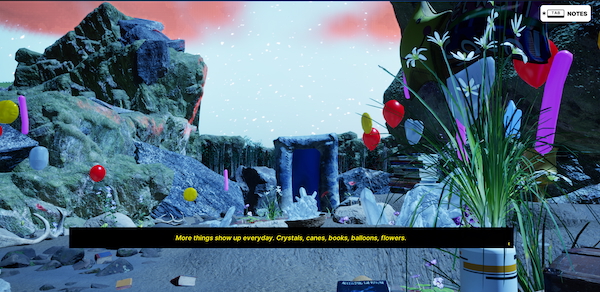
The game has three main locations. One is a grasslands and alpine meadow, the other is a grotto or a cave with hot springs, and the last one is an excavation pit where you can choose a model. The sound artists and musicians appear in the grotto location. It is full of all these objects that I was thinking of it as a material repository for all the objects that accumulate living with a disability. It was based on Lourdes. I’ve never been there, but I’m fascinated by pictures of this cave lined with dozens of canes.
Plants Properties Equipment screenshot
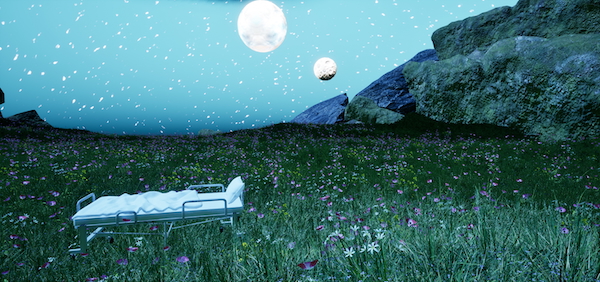
You’re led through the game by this character who I was thinking of as a crip doula, which is an idea developed by disability activist Stacey Park Milbern that when you’re newly disabled, the disability community helps you learn how to be disabled through advice, care, and community support. I say it’s an idea, because while it is true and I have experienced that to some degree, it’s also not a reality for everybody. There are a lot of people that experience this in an isolated way. I wanted to make this world specifically for disabled people. That’s who I was seeing as my audience. And I wanted it to be a beautiful place where you wanted to spend time. You’re led through the world by this being who you don’t see, who communicates through sound and captions, and who prompts you to make decisions. You move through the monolith area, jump around on the monolith, and then end up in the grotto and there’s all their stuff. It’s like this idea that you keep collecting stuff and the crip doula keeps keeping it there. There are “get well soon” balloons and a giant stack of Crip theory books. Some of it’s helpful and maybe some of it’s harmful. There are all these objects that have listen prompts connected to them. When you click them it goes to a black screen with captions for the song. Each artist has their own objects their song is connected to, and there are captions and audio description of the music. Each song piece functions in a different way that a soundtrack normally would, where it just happens ambiently during like discrete locations. I wanted the sound pieces to be accessible, so they’re translated through captions. Once you’ve listened to one of the songs, you can then enter the last stage, which is where you end up in this excavation point. For the whole game you are on this strange planet, and the prompt at the beginning is that you wake up on this starry night sky in a hospital bed and you need to seek care. It’s implied that you need to seek hospital care, right? But there’s no hospital on the planet. All there is is this grotto with a community. And then at the end, this excavation pit with the idea that maybe you could pick a different world or worldview.