Anne Sargent at Gallery 881, Vancouver
By Lin Li
Anne Sargent’s solo exhibition at Gallery 881 reminds me of the plot of No Exit. Jean-Paul Sartre’s existentialist play from 1944 recounts the conversation amongst three ghosts trapped in a locked room. This impression arises from the artist’s consistent focus on the human figure combined with her visual strategies – particularly her distinct image transfer technique – to create a multi-layered effect. Titled Twice Removed, the exhibition showcases Sargent’s most recent mixed-media works. The gallery space is occupied by “faces” created through a relatively complicated image-making process. Human figures are first painted by the artist, then photographed, and later transferred with gesso onto rag papers. The results add visual depth to the images while maintaining the overall minimalist aesthetic that Sargent has consistently adhered to throughout her artistic practice over the years.
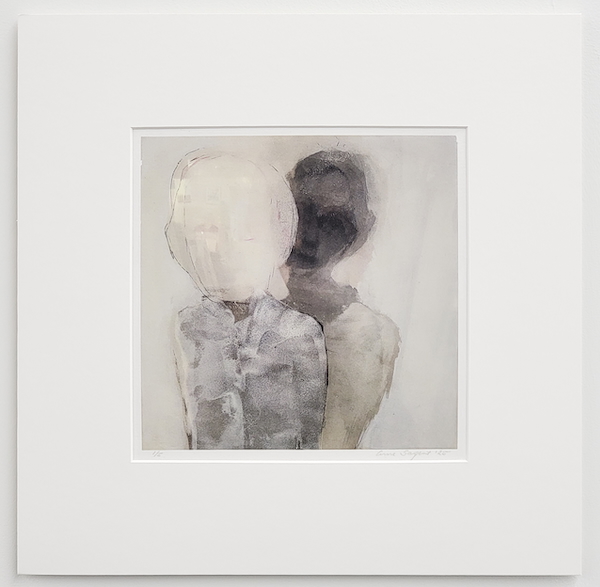
Anne Sargent, Shelter, 2025, gessoed photographic transfer onto rag paper
By deliberately blurring some details and selectively emphasizing the chiaroscuro of specific parts of the faces, Sargent’s portraits appear abstract, ambiguous, and ghost-like. The human figures depicted seem frozen in a moment, yet they also appear to be in constant flux – fading away only to reemerge more vividly, much like the interplay of shadows and light shifting throughout day and night. The media Sargent works with not only increases the overall complexity of visuals, but also enhances the overall chiaroscuro effects, creating invisible spaces inhabited by the human figures she depicts.
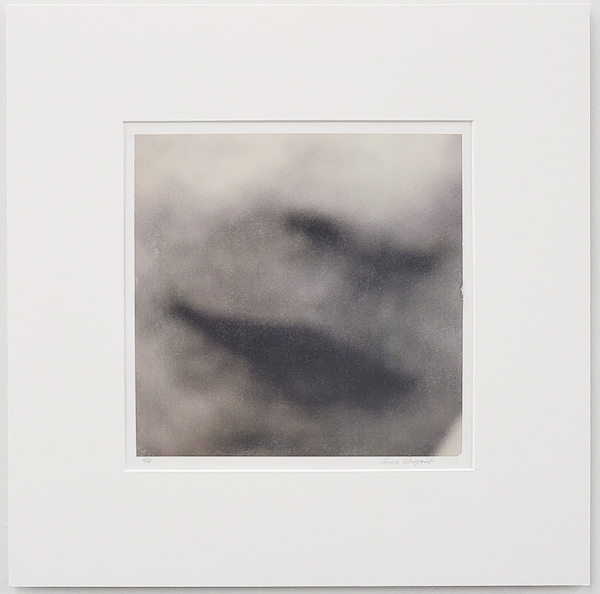
Anne Sargent, Fleeting, 2025, gessoed photographic transfer onto rag paper
Sargent mentioned in a conversation with me that the human figures she depicts are not based on any specific real-life models (aside from some references to her own face). She added, that throughout the repetition of her creative process, she feels the human figures she creates are “aging, transferring in gender, and changing in their facial details.” To Sargent, the face is an abstract subject with different layers of meanings hidden under the cover of visible visual clues. Human portraits used to be a classical and dominant subject in the history of fine art. Nowadays, artists of diverse disciples have given portraiture brand new meanings and contexts. The portraits they create, to some extent, have abandoned the pursuit of likeness, instead inducing illusions, challenging the viewer’s perceptions, and raising questions related to identity, gender, acculturation, and even the viewer’s self-awareness
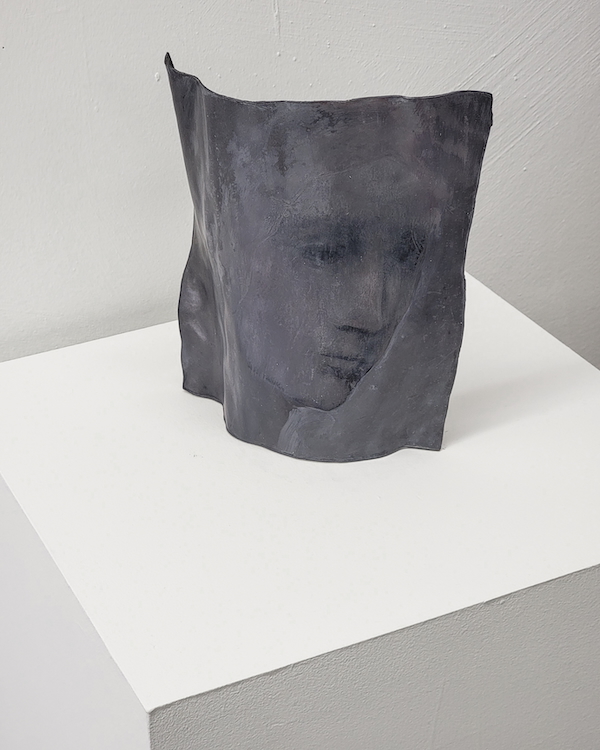
Anne Sargent, Madonna, 2025, oil paint and photographic image transfer on lead
Sargent’s multimedia works in Twice Removed remind me of the work of another Vancouver artist, Elizabth MacKenzie, who has also focused on the subject of the face for a long period, although her faces are based on specific people. In a conversation with curator Makiko Hara in 2020, MacKenzie mentioned that “any encounter with a face prompts a spontaneous, ethical response… the face represents the mortal and vulnerable Other toward whom we have a social responsibility.” MacKenzie’s ontological interpretation of the iconic meaning of faces partially echoes the reasoning behind the consistent subject choice of Sargent, who also treats the face as a conceptual theme and research subject to evoke the viewer’s retrospective and emotional response towards their self and others. Meanwhile, the artist says she also hopes to “give no meaning and share no stories of these faces I made, but leave the reception completely to the viewers.”
Anne Sargent: Twice Removed continues until March 29.
Gallery 881: https://www.gallery881.com/
The gallery is accessible.
Lin Li is an independent curator and writer based in Vancouver, on the ancestral and unceded territories of the xʷməθkʷəy̓əm (Musqueam), Sḵwx̱wú7mesh (Squamish), and səlilwətaɬ (Tsleil-Waututh) Nations. Her curatorial interests encompass a variety of topics, such as the decolonization and decentralization of Asian art, the identity crisis in an age of globalization and digitalization, and the contradictory, interconnected relationship between art and technology. She holds a Master degree in East Asian Studies from the University of Alberta.