Angelo Muredda on Disability in Film at TIFF 2026
Being Heumann
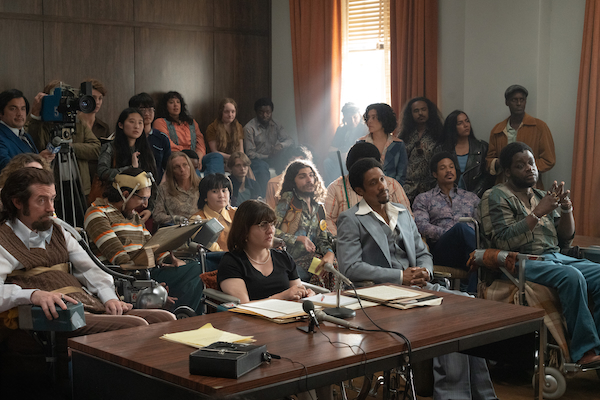
Clocking in at just under three hundred films, the Toronto International Film Festival is a big tent for patrons to amble through, depicting just about any cultural interest its diverse audience of civilians, critics, and industry powerbrokers might want to see. Diffuse as it was, the festival’s 51st edition cast a bright spotlight on disability, not least because of the splashy world premiere of the opening night film, Oscar-winner Sîan Heder’s Being Heumann, a rousing but safe biopic of the life and work of disability activist Judy Heumann. A rare case of authentic casting come to fruition on a grand scale, with zero Eddie Redmaynes or Freddie Highmores doing broad disability mimicry for the rafters, Being Heumann is also a disappointment as a film – its failings proof that good disability storytelling needs more than just representation and accessibility. For that, TIFF patrons had to look a little farther afield.
Tender Loving Care
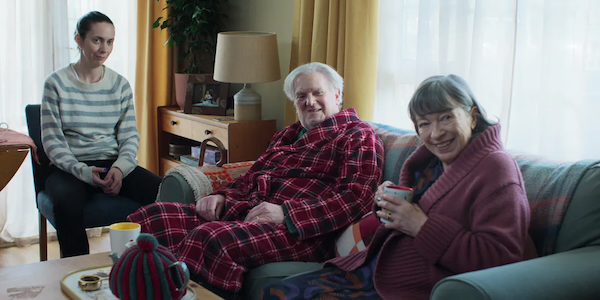
Navigating the festival with an interest in disability means having one’s finger on the pulse of its recurring themes. Among those this year was a crop of films about the unsung labour of care work, owing perhaps to the advancing age of the filmmakers or their parents, as one of my colleagues suggested on our way to a screening. The subject was explored in films such as Mike Leigh’s warm and wonderful (possible final) film, Tender Loving Care, which profiles a pair of social workers as one of their parents faces a sudden health crisis that casts her work into sharp relief. The thanklessness of care work is also central to Ira Sachs’ The Man I Love, a period drama about an actor named Jimmy (Rami Malek) who is dying from AIDS and divides his last days between rehearsing for a play, starting a fresh romance with a new neighbour, Vincent (Luther Ford), and running lines with his long-suffering partner Dennis (Tom Sturridge), who manages his complex medical care while Vincent sees only the good stuff.
All of a Sudden
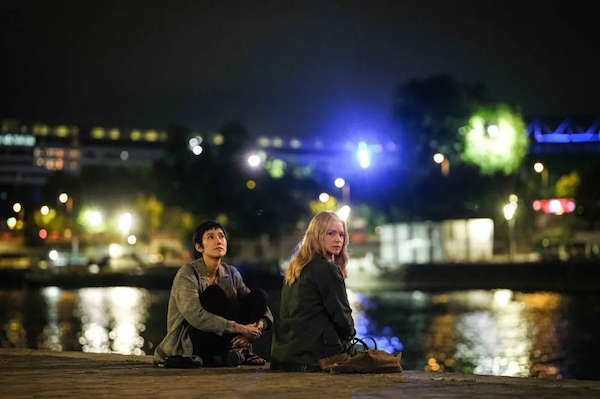
With the exception of the evocative opening and closing moments of Leigh’s film, which offer a poignant image of an artist looking into his future on the edge of retirement and diminished physical capacity, these films largely centre the work of the provider over the disabled and ill recipient of care. That focus is shifted by Ryusuke Hamaguchi’s impossibly nuanced All of a Sudden, which weaves multiple disability experiences into its dense narrative fabric. The Academy Award-winning director of Drive My Car returns to some of that film’s subjects of disability, grief, and art in this story about the similarly named Marie-Lou, the French manager of a radical and underfunded patient-centred care facility for those with dementia, and Mari, a terminally-ill Japanese playwright whose work centres on the effort to de-institutionalize psychiatric patients, played by Virginia Effie and Tao Okamoto, who shared the Best Actress prize at Cannes. After a chance encounter on the bus where Marie-Lou comes to look after Tomoki (Kodai Kurosaki), the autistic grandson of the Japanese actor Gorō (Kyōzō Nagatsuka), who is starring in Mari’s play (which Tomiki frequently interrupts on stage in what’s effectively a relaxed performance) about the dissolving of asylums and reintegration of disabled people into everyday life in Italy, the women strike up a life-changing friendship. That connection is predicated on their long, philosophically deep conversations about capitalism, care, illness, and burnout. The women’s beguiling first conversation, rendered nearly in real-time in the first half of the sprawling, 197-minute film, as they walk from Mari’s theatre to Marie-Lou’s nursing home (itself a former asylum) and then stretch across its grounds is a magic act, anchoring a rigorous analysis of austerity and the mechanization of workers’ bodies and minds in a moving dialogue between two women simply enjoying each other’s ideas and company with the little time they have left.
Iron Boy
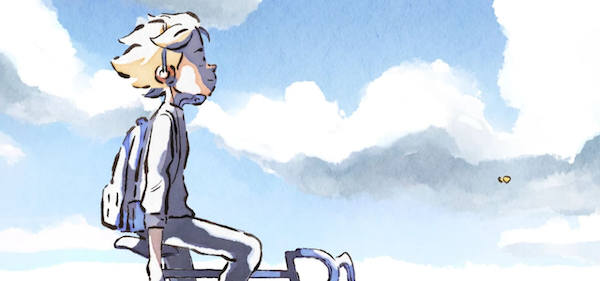
If Hamaguchi’s film provokes debate about the unsustainable nature of human-centred care in a time of privatization, and amidst the normalization of physician-assisted dying – which is represented to different ends by Canadian selections like Denis Côté’s dystopian satire Nobody’s Violence and Sophie Deraspe’s lyrical documentary The Final Act – other TIFF films dismantled the stereotype of the supercrip: the disabled individual who heroically defeats disability by developing compensatory super-abilities that supposedly make up for their impairments. The trope is all but named and subverted by Iron Boy, Louis Clichy’s refreshingly unsentimental hand-painted animated feature. The children’s film tells the story of Christophe, a farm boy whose worsening scoliosis requires him to be outfitted with an iron back brace, which keeps him from participating in harvest season and relegates him to gendered housework with his mother in exchange for the apparent superpower of being able to help his crush Clara shoplift from the local convenience store, because, as she points out, nobody would dare ask a visibly disabled boy why he’s setting off the metal detector. A lovely, understated film about listening to and changing with one’s changing body, Iron Boy resists the temptation to make Christophe transcend his disability the way you might expect. As the no-nonsense organ teacher at his church teaches the decidedly not-special hero when he fixes an adjustable mirror on the imposing instrument so Christophe can watch his hands on the keys without having to crane his neck, disability here isn’t something to get over but to adapt to — an opportunity for creativity and ingenuity as well as periodic discomfort.
Run Terry Run
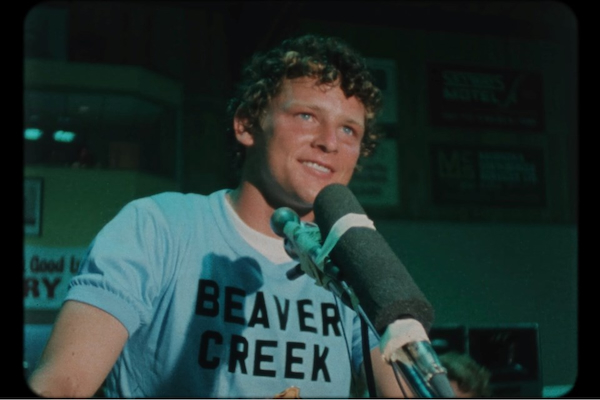
Another potential disabled boy wonder adapts to the needs of his changing body in Sean Menard’s Run Terry Run, a deep dive into Terry Fox’s cross-Canada Marathon of Hope as told from the perspective of his brother Darrell, closest friend and driver Doug Alward, and Toronto Star journalist Leslie Scrivener, who offer audio commentary over evocative archival footage of the 143-day and 5000 kilometre-spanning fundraiser for cancer research. What might have been a standard talking-head docudrama about an inspirational disabled figure from recent Canadian history – and which threatens to become one whenever the composer lays it on thick with the manipulative score – is nuanced by the decidedly not media-friendly footage of Fox’s grueling morning runs and the physical toll they took on his stump, with blood occasionally seeping through the stocking of his prosthetic leg to the point where onlookers eager to catch a glimpse of him were sometimes treated to a gory sight. That might not be the usual stuff of a motivational documentary, but it’s a welcome corporeal detail that helps us pluck Fox out of the clouds his public persona has ascended to since his death from cancer in 1981, and anchor him in his disabled body. That embodied portrait extends to the humanizing moments where we see a bemused and irritable Fox reckoning with becoming a symbol of hope and perseverance when all he wants is to run and raise money. At odds with his public image as a figure of pure uplift, Fox comes across as a straight-shooting jock who’s accommodated himself to life as an amputee with cancer, capably translating his pre-cancer athletic aspirations (and educational background in kinesiology) into the run of his life.
Being Heumann
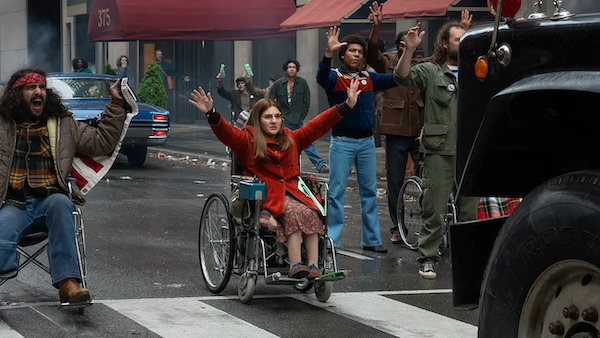
As popular as Run Terry Run is likely to be on the Canadian specialty theatre circuit when it opens this fall, the elephant in the room where TIFF’s disability movies are concerned is still Being Heumann, Heder’s follow-up to her Best Picture winner CODA. Given her previous film took some fair knocks for centering its drama on a hearing singer in a family of Deaf fishermen and women, Heder is wise to focus squarely on Heumann’s tireless, sometimes crotchety activism in the days leading up to and during the monthlong 504 sit-in of 1977, perhaps thanks to the lived experience of her disabled screenwriting partner, Rebekah Taussig. Ruth Madeley, of Years and Years, makes a very strong impression as an uncompromising Heumann, a professional organizer to her bones, who can’t fathom that some of her disabled comrades might not have the same spoon or resource allocation as her to sit the protest out for the long haul. Along with a cast of fellow disabled performers like Rio Finnegan and Daniel Durant – not to mention numerous Southern Ontario disabled performers who add local colour and texture in largely non-speaking roles – Madeley’s prickly, bold performance makes a great case for the value of authentic casting: you buy her in her rage, her utopian desire for a just world, and, crucially, in her more earthbound desires for both friendship and sex. Where a nondisabled actor might have hammed it up in her wheelchair or played Heumann’s rare flaws as tragic, Madeley lets her simply be a person.
A crowd-pleaser to a fault, Being Heumann is also an awkward touchstone for how far disability representation still has to go, when the production is radically accessible but the filmmaking is pedestrian. Apart from an interesting opening POV shot tethered to the back tire of Heumann’s wheelchair as she bobs and weaves through street traffic in the absence of accessible sidewalks and curb cuts, which recalls the experimental wheelchair-dolly photography of Reid Davenport in I Didn’t See You There, there’s very little effort to capture the embodied experiences of the protestors. Conversely, there are far too many clunky, expository scenes of characters explaining the stakes of the legislation they’re fighting for, a case of preaching the disabled activist gospel to an assumed nondisabled audience, for whom such matters as equal access to employment, education, transit, and infrastructure are nice-to-haves rather than fundamental human rights.
In her opening remarks at the world premiere, Madelay celebrated Heder as an ally whose commitment to making a “Hollywood movie with disabled people at the centre” extended from the casting of actual disabled performers to the building of a wheelchair accessible set and trailer. That she had to say “Hollywood movie” at all speaks to how disabled audiences still have to look elsewhere for more daring and complex portraits of the disability experience, even when the behind-the-scenes production details of a film like Being Heumann feel revolutionary.
Angelo Muredda is a Toronto-based teacher, film critic, and programmer. His writing on film has appeared in outlets such as Cinema Scope, The National Post, The Walrus, Now Magazine, SHARP Magazine, and Film Freak Central. He teaches in the Department of English at Humber College, where he is also Reviews Editor for the Humber Literary Review.