An Atlas of Uncertainty at The Rooms, St. John’s
By Allison Graves
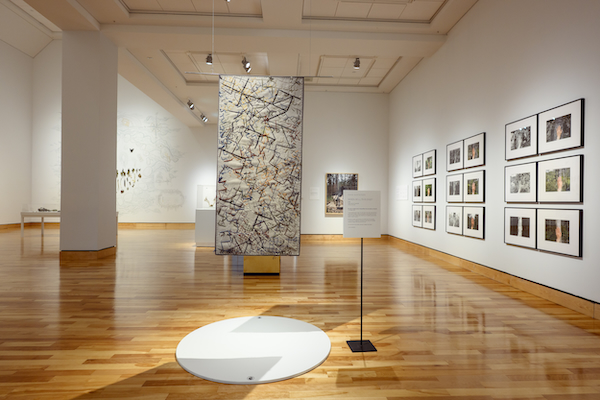
An Atlas of Uncertainty, 2026, installation view (photo: Ritchie Perez)
This spring, after my mother got sick, I began to knit Sophie scarves. Sophie scarves are an online phenomenon that my Instagram explore page wouldn’t let me forget. I drove to North York in Toronto and bought four balls of Nordic cashmere yarn in beautiful primary colours. This particular yarn store was far enough away from my parents’ house that it was hard to justify the gas money, but I couldn’t be stopped. The scarf I made didn’t end up feeling satisfying to hold and ultimately felt frivolous to wear, but it saved me during that hard time. This is what I was thinking about when I roamed the expansive fourth floor of The Rooms to see An Atlas of Uncertainty. The exhibition, curated by Mireille Eagan, is a response to constantly shifting realities that leave people feeling unsettled. It asks not only the artists, but also the public: how do we live in constant crisis and change?
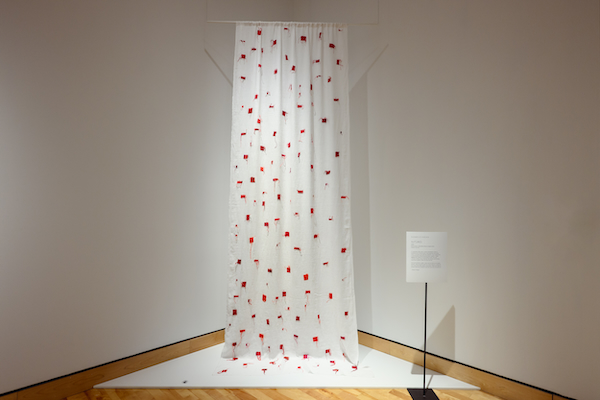
Shawn O’Hagan, Sutures, 2026, embroidery floss on organic linen (photo: Ritchie Perez)
Directly beside the front door of the gallery is a long piece of organic linen draped from ceiling to floor. It is embroidered with slightly different shades of red floss in haphazard shapes – mostly squares. Sutures by Shawn O’Hagan was created as a response to the artist’s surprising breast cancer diagnosis. In their description of the piece, O’Hagan says that each day they would stitch while waiting for their biopsy results in an effort to “hold fear and sadness, and to bring myself back together.” I thought again about the Sophie scarf. When I turn around there is another textile piece. Anna Gustafson’s When Will This End? – through its multicoloured yarn embroidered in sort of a sporadic and anxiety-inducing way on grey wool felt – is particularly interested in webs: the kinds of connections we weave that may induce chaos, but also help keep us alive.
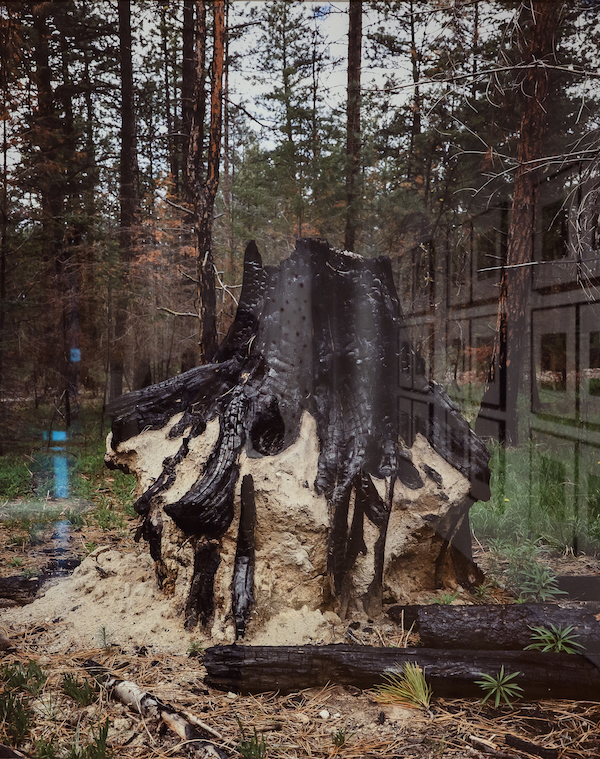
Andreas Rutkauskas, Nk’mip Creek Wildfire, 2021, photograph (photo: Ritchie Perez)
Last week I flew back to Newfoundland as wild fires stormed Ontario, leaving the air thick and the sky orange. The complete decimation of communities all over Ontario has left me feeling unsettled ever since. In this exhibition, I noticed there was a lot of commentary on fires. Emily Jan included artifacts from the St. John’s fire of 1892 in Mappamundi: Fire and Water. Andreas Rutkauskas’ photograph Nk’mip Creek Wildfire shows a charred tree stump rising from pale ash. This and Marlene Creates’ nearby work make me think about land shaped by loss – how a landscape changes after destruction and how it can regrow.
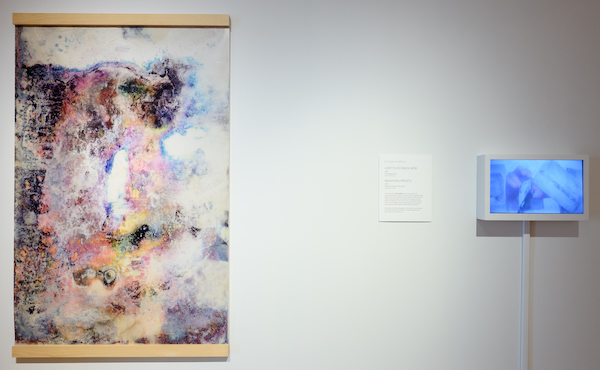
Ethan Murphy, Untitled (Back #18) & Washing Prints, 2019, chromogenic print & video (photo: Ritchie Perez)
I finish the show by watching a video installation titled Washing Prints by my friend Ethan Murphy. In this work he reckons with the loss of his father after finding clusters of four-by-six photographs, damaged and fused into solid blocks. Footage of him separating the blocks of photos plays beside a large chromogenic print of one of the destroyed images. Unlike the opening works that looked to solidify and merge, Murphy is pulling things apart and seeing what that renders. What mesmerized me the most was the feeling it conjured in me. I felt anxious and on edge, and thought about Ethan and his lack of control over the image he would eventually separate from the fused block. He couldn’t know how it would survive. I thought about sitting with this lack of control and being open to the possibility of new sorts of images emerging from the old ones. And then I thought that was the whole point.
An Atlas of Uncertainty continues until September 20.
The Rooms: therooms.ca/exhibits
The gallery is accessible.
Allison Graves is a writer and PhD candidate from St. John’s, Newfoundland. Her book Soft Serve was published in 2023.