Alexis Bulman on Surveying the Community
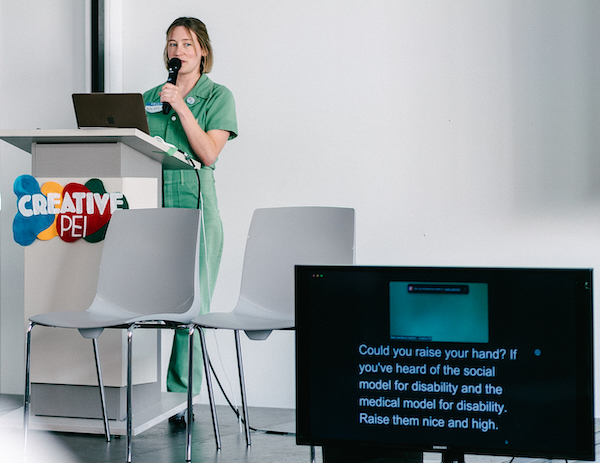
Alexis Bulman’s presentation at Creative PEI’s Arts, Access, & Wellbeing Conference, November 7, 2025 (photo: Andrew Lewis)
In addition to being an artist, Alexis Bulman is the digital accessibility coordinator at Creative PEI, a nonprofit arts organization whose mission is to improve the incomes and outcomes of artists working in all of the creative sectors. Akimblog recently spoke with her about their ongoing Accessibility & Barriers Survey.
I must have written a hundred questions to start the survey. Having worked as an artist for twenty years, I’ve encountered a ton of barriers that have negatively impacted my ability to show work in settings that I don’t know are inclusive or provide good experiences for me as an artist – let alone for the audience. So I had an idea of the questions that I wanted to ask, and some of the theories I thought would be revealed through the survey results, but the thing that was really surprising is that it was completely surprising.
We ended up using a very cool platform to host the survey called Accessible Surveys. What’s neat about it is that it’s built with access tools in mind. Users who interact with our survey can increase the screen size and the contrast and the lettering. They can leave the survey and come back to it and it never times out. Instead of filling out the survey with typing, you can do recordings instead. There are a ton of access tools built right into it.

A panel discussion at Creative PEI’s Arts, Access, & Wellbeing Conference, November 7, 2025 (photo: Andrew Lewis)
I worked with my colleague Rachel Matheson. She’s neurodivergent and has a physical disability, and I have a physical disability, so we were able to pull in some different perspectives. She and I got together at the very start of the survey and made a list of all the people that we could think of in the arts community here in PEI who might fill it out. We came up with fourteen people. We thought fourteen was actually a lot of people because this island is small and the arts community is even smaller. To our surprise the survey got eighty-two responses in the end. We were completely blown away. It just shows that we’re here and that we want to engage.
One of the theories I’ve had for a long time is when there are physical and systemic barriers in an arts community, it prevents folks with disabilities and neurodivergence from forming community. If you go somewhere and you’ve had a negative experience, you’re less likely to reengage at that venue or with that artist-run center. You stop showing up to things because of negative experiences that are informing your present or your future. If there are physical and systemic barriers, we’re prevented from forming community because we can’t get together. And when we can’t get together, we can’t collaborate or share ideas or thrive creatively and inspire one another. When there are these barriers, we are prevented from being included, and that prevents us from having these awesome artistic careers and feeling creatively fulfilled. That was one of my number one theories going into this. Part of that theory was that I didn’t know a lot of other artists with disabilities, and I figured maybe that’s because there are so many barriers.
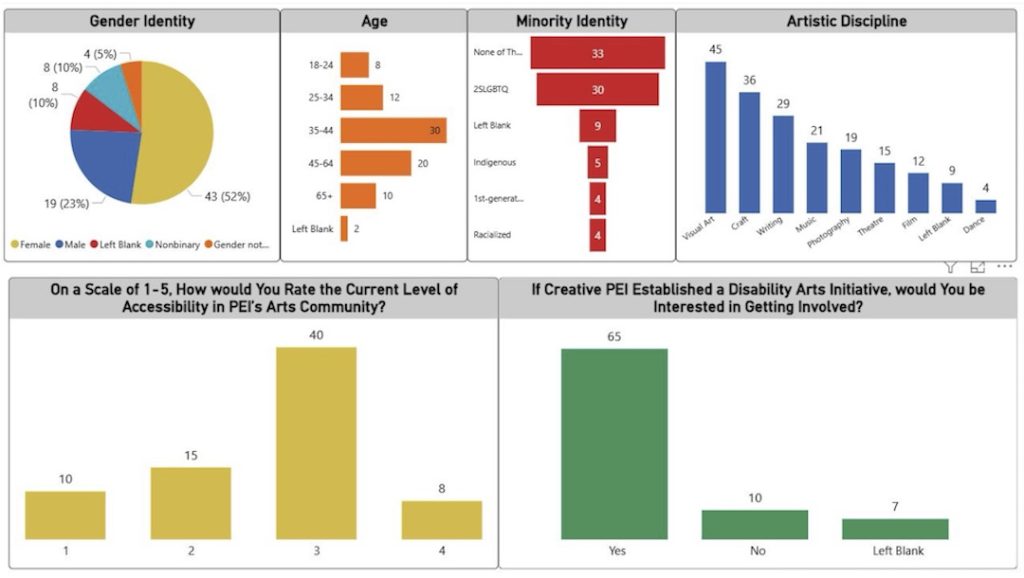
A slide from Alexis Bulman’s presentation at Creative PEI’s Arts, Access, & Wellbeing Conference, November 7, 2025
We worked with Holland College’s data analytics department. They’re a local college and they helped us format the survey. We also worked with ResourceAbilities, which is a council for persons with disabilities in PEI. I engaged with both of them because I was having a lot of issues formatting some of my questions. I was trying to figure out, for example, if was it important for us to know that, say, eighteen of the applicants identify as being partially blind or partially sighted. Or is it just important to know the types of barriers that people encounter? ResourceAbilities helped me identify what was at the root of the issue I was struggling with, which was that I wasn’t aware I was walking the line between following a medical model for disability and the social model of disability. Once I had that understanding, I was like, “Well, social model it is.”
What we really learned by formatting the entire survey through a social lens was that, because there’s so much stigma around disability and asking for help, we wanted everyone to feel completely anonymous so that they could feel completely safe. The survey question concerning the decision to disclose was one of the most difficult ones. The thing that was so devastating about the results of that question is that half of the respondents said they fear people won’t believe that the barriers they face are valid or significant. This shows us how much stigma there is in the arts community, and that a lot of unlearning needs to happen. From the perspective of the people who are trying to participate, who have had the bad experiences in the past, we’re afraid that the barriers we face won’t be seen as valid because we’ve been made to feel that like that. That’s not coming from nowhere.
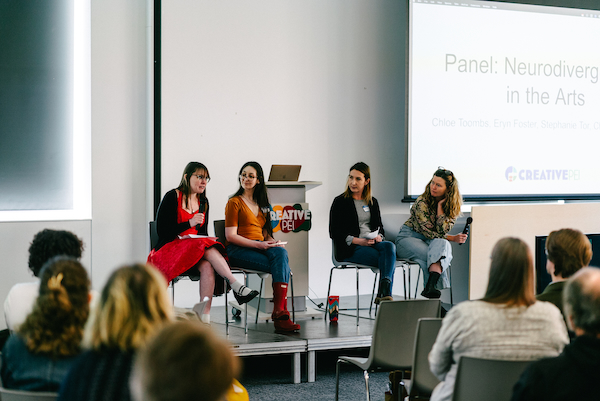
A panel discussion at Creative PEI’s Arts, Access, & Wellbeing Conference, November 7, 2025 (photo: Andrew Lewis)
On the flip side, what’s great about PEI right now is we have all these art galleries and art festivals and music programs, and a lot of them have accessibility coordinators on staff. We have organizations who are demonstrating that they’re listening and that they’re trying. One of the survey questions concerns what access tools are used for online events. Another asks which access tools do you use for in-person events. When people think about what an access tool is, the most clichéd or obvious thing that comes to mind would be a ramp or an automatic door button or an ASL interpreter. But actually the things that are highest on the list are accessibility statements and quiet spaces. What the survey is really showing is that some of the most wanted access tools for online and in person are extremely low cost. It doesn’t cost money to dim lighting or to do a relaxed performance. I mean, there is value cost in people’s time, but writing an accessibility statement and making sure there’s a quiet space, we can do those things. We just need training and know-how and the patience and dedication to do these things diligently.
One thing I always like to say is there is no such thing as a barrier-free anything. One person’s barrier is another person’s access tool, and one person’s access tool, another person’s barrier. A classic example is some people who are immunocompromised would prefer that everybody wears masks, but people who are hard of hearing who might rely on lip reading and a mask can be a barrier to that access tool. My advice to anybody who’s planning a survey like this is it’s not going to be perfect. Especially not the first time. If I made the survey again today, I would ask a lot of different questions. I also might ask questions in a different way to try to reach different people. The people who are most likely to engage with these surveys are the people who probably face the fewest barriers. And you can make the argument that the people we need to hear from the most are the people with the most barriers.