2025 Critics’ Picks – Part Two
Once again, Akimblog has reserved the last two weeks of our publishing year to reflect on the past twelve months of art happenings in Canada. Our writers have selected the exhibitions that stuck with them long after they left the gallery. At a time when it’s hard not to spend every waking moment absorbed in politics, contemporary art can help us make sense of the chaos, respond to it, and provide respite from it. This list is a tribute to those possibilities.
Jenny Western in Winnipeg
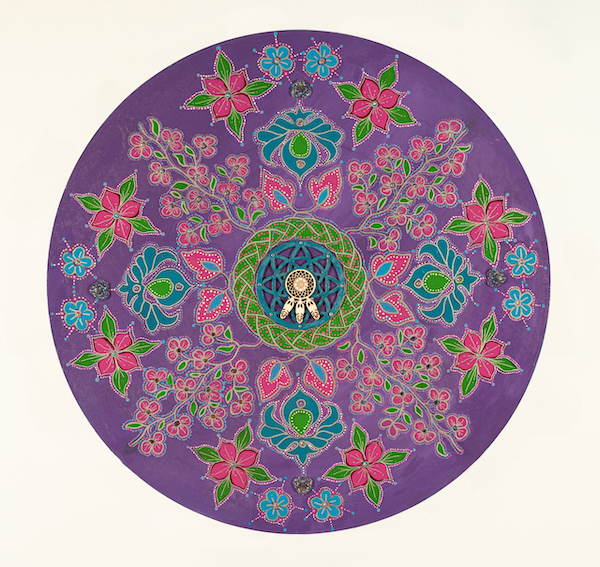 Lita Fontaine, Purple Sweetgrass, 2023, mixed media on wood panel
How can you present a comprehensive and balanced year-end review of an art scene that consistently hits above its weight for arts and culture? My 2025 picks for visual culture from Winnipeg are far from an exhaustive list, but here are a few highlights from this past year.
After an eleven-month run, Lita Fontaine’s Winyan closed at WAG-Qaumajuq in June. Fontaine is one of the founding members of Urban Shaman gallery, helping to establish the Indigenous artist-run centre in Winnipeg’s Exchange District in the 1990s. Over the years her strong and steady arts practice has been an inspiration to many artists, and yet still deserves more critical attention than it has received. Major kudos to Fontaine and WAG-Qaumajuq’s assistant curator of Indigenous and contemporary art Marie-Anne Redhead for making this much needed and beautiful solo exhibition happen.
In October the WNDX Festival of Moving Image celebrated its 20th anniversary. A festival that celebrates independent and experimental film by local creators alongside international creators, WNDX’s programming has not grown stagnant in its longevity. In addition, WNDX used this year as an opportunity to honour the life and work of Jaimz Asmundson. Asmundson, a stalwart of Winnipeg’s film community and one of WNDX’s main organizers for many years, passed away in 2024, leaving a legacy of campy, transgressive, visually stunning films in his wake. “Goths! On the Bus!” forever!
Michael Davidge in Ottawa
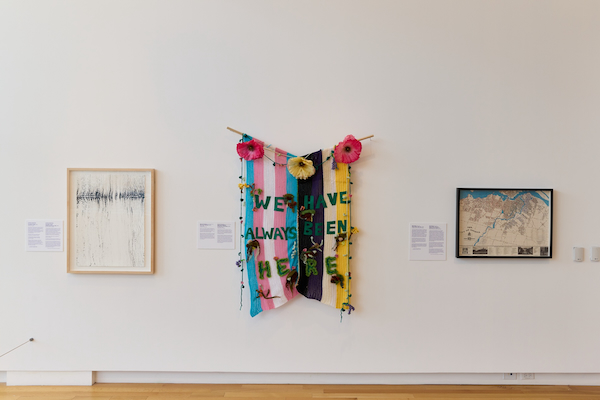
Grotto: The Bill Staubi Collection, 2025, installation view at the Ottawa Art Gallery (photo: Rémi Thériault)
As I began composing my reflections for Akimbo’s year-end round-up, I heard that the Alberta government had passed bills negatively affecting the rights of transgender people in that province. Against a backdrop of the dire spiral of the news cycle, rife with such stories of discrimination, I am glad to have the opportunity to cite some queer positive moments in the Ottawa-Gatineau arts community this past year.
Fundamentally an expression of queer joy, Grotto: The Bill Staubi Collection opened at the Ottawa Art Gallery in March. Curated by Sam Loewen and Caro Stewart, the exhibition consists of works donated by a local art collector to the permanent collection at OAG. Bill Staubi’s support for emerging artists and queer artists in particular will have a lasting impact on the way art history in Ottawa can be told. The gallery has also established the Bill Staubi Acquisition Fund, furthering institutional support for emerging artists from the 2SLGBTQQIA+ community. One of Staubi’s most recent purchases on view, Blooming Together from 2024, is by the artist Saivani Sanassy (Ubuntu Art House), whose interactive fibre arts performance was also a welcoming part of the spring edition of Pique, an interdisciplinary arts festival that enlivens Ottawa four times a year.
Adorning Sanassy’s piece, replete with the colours of the non-binary pride flag, the phrase “We Have Always Been Here” echoed within another highlight of the arts calendar: a major retrospective exhibition of the trans artist Erica Rutherford at the National Gallery of Canada this summer. Rutherford’s The Diver from 1968 was purchased by the NGC this year, indicating the growing recognition of the historical importance of her contribution and offering a radical revisioning of Pop Art’s representation of gender and sexuality. I hope to be able to share more good news like this with you next year.
oualie frost in Montreal
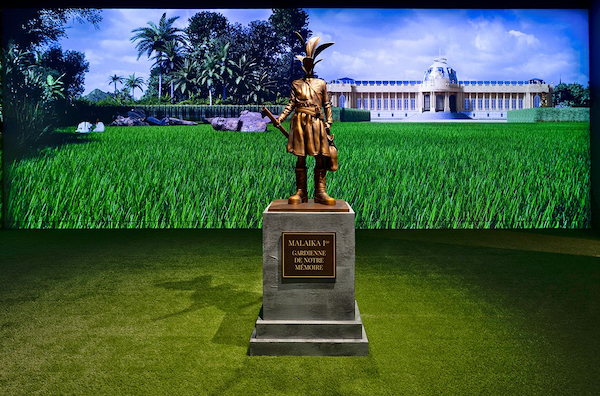
Moridja Kitenge Banza, Once Upon a Time, Malaika, 2025, installation view (photo: Michael Patten/VOX)
Sometimes, straying off the path is fun. Twice now, while visiting particular exhibitions to write reviews, I’ve discovered another one at the same gallery and had a great time. Thus, my 2025 Critics’ Picks are dedicated to the side quests, two shows that left me impressed despite only finding out about them incidentally.
In a space aptly named “the bunker”, Rick Leong’s The Night Blooms at Bradley Ertaskiran is a wonderful example of site specificity. Clambering down stairs and going through a cave-like hallway, entering the space felt like emerging through the willows into an enchanted fairy grotto. Inspired in part by Chinese pottery, Leong’s works touch upon both diaspora and ecologies of interrelation. Large, life-size paintings in cool tones evoke a sense of feralness and the sublime of untouched nature. Critters play hide-and-seek amongst the bounty of twilit branches and leaves, undisturbed by the viewer who can almost feel the breeze.
Moridja Kitenge Banza’s Once Upon a Time, Malaika at VOX, plays with history in a way meant to encourage youth to critically examine the stories they are fed. As seen through the eyes of the time-travelling character Malaika, historical narratives are revisited through a decolonial lens and presented as if a museum exhibition. Rather than dedicating statues to colonizers, one is dedicated to Malaika. Rather than showing artefacts stolen, items like a borderless map and medicine bag are shown, giving the glory to decolonial narratives.
Though I hadn’t been aware of either before attending, both were equally as enjoyable as the shows I had planned to see. Moreover, both felt accessible to the viewer, allowing them to be appreciated without prior reading or knowledge. The pleasant surprise of The Night Blooms and Once Upon a Time, Malaika are what makes them my 2025 Critic’s Picks.