2025 Critics’ Picks – Part One
Once again, Akimblog has reserved the last two weeks of our publishing year to reflect on the past twelve months of art happenings in Canada. Our writers have selected the exhibitions that stuck with them long after they left the gallery. At a time when it’s hard not to spend every waking moment absorbed in politics, contemporary art can help us make sense of the chaos, respond to it, and relieve us of it. This list is a tribute to those possibilities.
Ogheneofegor Obuwoma in Vancouver
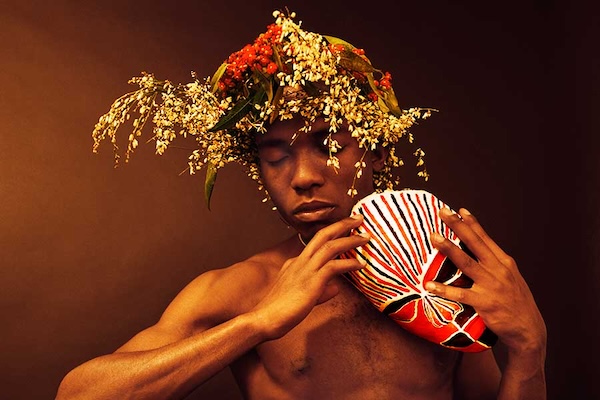
Rotimi Fani-Kayode, Adebiyi, 1989. Courtesy of Autograph (London)
The Polygon Gallery’s exhibition Rotimi Fani-Kayode: Tranquillity of Communion left a lasting impression on me this year. It traced Fani-Kayode’s short but seminal career, sharing diverse photographic works, collaborations, and archives. His photographs explored the complexities of his life as a Gay Nigerian man living in England after leaving Nigeria as a child during the Biafran War. I especially connected with images weaving Yoruba spirituality and lens-based possibilities that feel expansive during a time of increasing social control across the world. Fani-Kayode offers a resistant approach to facing the world through image-making. Co-organized by Autograph in London and the Wexner Center for the Arts in Columbus, Ohio, the show celebrated a vital queer artist whose work exemplified the vibrant counterculture of 1980s London.
The Vancouver Art Gallery’s mid-career survey exhibition of Firelei Báez’s work was another memorable experience. Báez, an American-based painter, channels both the everyday and the monumental in Black women’s lives with paintings and installations that create a layered sensory experience and bear witness to entangled histories and possible futures. I was captivated by the devotional and archival depth of her paintings.
Finally, I can’t end my picks without mentioning Lisa Reihana’s in Pursuit of Venus [infected] at the Museum of Anthropology at UBC, which, though it closed in early January, left a strong impression on me throughout the year. The innovative panoramic video installation blurred lines between moving image and photography, speculation and historical truths. Reihana, a Māori artist, reimagines first encounters between British and Pacific Indigenous peoples, unravelling colonial narratives through striking, distinct visual storytelling.
Levin Ifko in Calgary
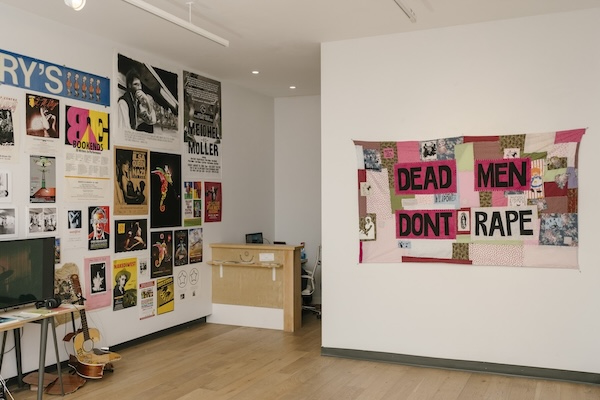
Installation view of Dreaming Asleep, Dreaming Awake at The New Gallery (photo: Danny Luong)
The first exhibition I wanted to highlight this year is Dreaming Asleep, Dreaming Awake, which features work from local artists Helen Arias, Jordan Baylon, and Peter Moller. This group exhibition at The New Gallery not only marked TNG’s 50th Anniversary, but more pressingly perhaps, generated reflections about the legacies of artist-run-centres as a whole. In the adjacent publication of the same title, artists and directors of TNG’s past and present share thoughts about their time being involved with the space.
Among these reflections, I was prompted to ask, what could the role of an artist-run-centre be in the visual arts sector and beyond? How has this role changed since their inception? And are we asking these questions because of burnout, and is this burnout a result of continuously having to prove the worth of these spaces?
Another two exhibitions that I wanted to highlight, are Hummingbird Guided Meditation by Miruna Drăgan and Maggie Tiesenhausen at Contemporary Calgary, and Megan Feniak’s With All Our Vernal Suns, in Esker Foundation’s Project Space. I found myself responding with a similar fondness towards these two works. Where Drăgan and Tiesenhausen’s audio-visuals were intimately scaled to the hummingbird’s universe in a garden, Feniak’s work brings a grounded material closeness to the incomprehensible scale of our solar system.
I must also highlight the monumental Jana Sterbak retrospective currently at Esker Foundation. Curated by Naomi Potter, Dimensions of Intimacy is a moving look at the senior Canadian artist’s work from the last fifty years. The exhibition text includes a reflection of Sterbak’s where she outlines a preference to call her work “objects” or “situations” rather than “sculpture,” with the goal of not relegating her pieces to the art world alone. Sterbak notes: “A really successful work of art has the ability to make us reconsider our perceptions – not only inside the museum, but also out in the world.” I wanted to share this reflection here, as it seems to bring up a desire I found reflected throughout many local exhibitions and programs, and in one-on-one conversations I had about the arts scene this year. I encourage you to see this exhibition before it closes on December 21. If you can’t make it, be sure to look out for where it may be touring in the future!
Terence Dick in Toronto
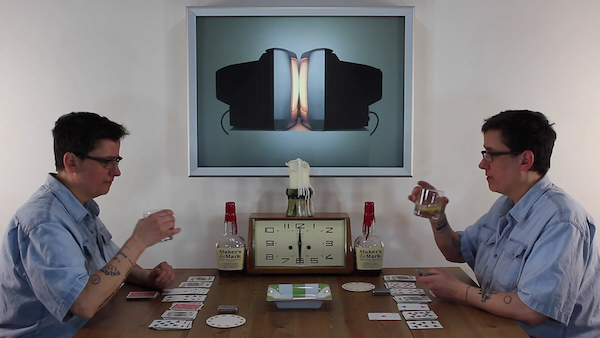
Kelly Mark, 108 Leyton Avenue, 2014, video
One of the decisive moments in my entry into the world of contemporary art occurred when I stumbled into a small exhibition at the Art Gallery of Ontario way back in 1997. At that stage of my life, I had heard about the artists whose works could be found on Sonic Youth album covers, but not many more. The gallery of familiar objects, some of which had been completely covered by pencil lead, grabbed me in a way I hadn’t experienced before. And I was surprised to learn that the artist was from Toronto and roughly my age. Everything that I would come to love about art could be found in that exhibition, especially the way a work could pull the rug out from under you and leave you hanging in a conceptual and emotional freefall. I couldn’t stop thinking about the simplicity and immensity of a metal bar titled Object Carried for One Year.
The exhibition was part of a series at the AGO featuring emerging artists titled Present Tense. The artist was Kelly Mark, and her work would become a consistent presence in the Toronto (and Canadian) art scene in the subsequent decades, included in large scale public exhibitions at The Power Plant and in Nuit Blanche as well as through commercial galleries like Wynick/Tuck Gallery, Diaz Contemporary, and Olga Korper Gallery. Mark passed away in March, and this fall a group of galleries presented Everything & Nothing, a wide-ranging collective exhibition of her work that served as a testament to her consistently compelling practice, her tireless labour that transformed pointless exercises into sublime moments, and her deep connections to Toronto’s visual arts community. Olga Korper anchored the exhibition, but participating spaces ran the gamut from the old guard (Vtape, Art Metropole, MOCA, The Goldfarb Gallery [née the Art Gallery of York University], and goodwater gallery) to the new kids on the block (the plumb, Joys, and Pumice Raft). For an artist so obsessed with the passage of time and, at times, explicitly addressing the fact of mortality, her exhibition put not just this year in perspective, but the past three decades.
Liam O’Brien in Halifax
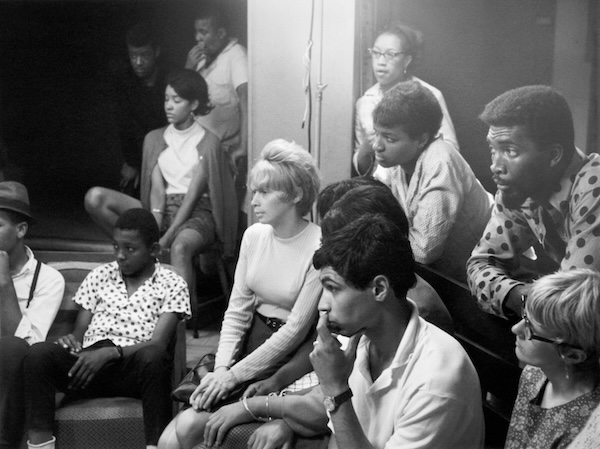
Encounter at Kwacha House – Halifax, 1967, film still, directed by Rex Tasker, produced by Barrie Howells and John Kemeny (courtesy of the National Film Board of Canada)
Reflecting on arts events in Halifax this past lap around the sun, the Dalhousie Art Gallery stands out as the host of some of the year’s most memorable art-viewing experiences. As a Dalhousie student, I’m partial towards the gallery in all its mock-Met Breuer magnificence, and its frequent spotlighting of young curatorial talent. One such example was this summer’s Broad/Cast: Reclaiming Representation, curated by recent NSCAD graduate Geoffrey Webster. The show explored the intersections of race and the moving image through a tight selection of experimental and documentary film spanning decades and projection scales. Visitors were first met with Rex Tasker’s fascinating Encounter at Kwacha House – Halifax, a vérité NFB documentary from 1967 capturing a candid conversation between Black and white Haligonians about race relations in the city. From this situated point of departure, the exhibit’s other works moved abstractly through questions of corporeality, history, and (mis)representations through the lens, in tones from fuzzy VHS to refined digital. In 2026, here’s to more shows which explore these universal questions from a hyper-local standpoint, offering a sense on what it means to live here.
My honourable mention for 2025 was Charlie MacLean and Emma Chapman-Lin’s Real Estate Agent vs The Angel of History – my favourite piece from Nocturne, Halifax’s outdoor night-time arts festival. This puppet-show film – strategically projected onto the concrete wall of a new condo under construction beside a rubble pile that was once St Patrick’s-Alexandra School – satirized the virtual-apartment-tour format. As a mundane estate agent moves us through a ghastly apartment, he gets interrupted by the pesky Angel of History, who waxes poetic on the changes happening in our city, and all the potential squandered with successive waves of urban development. In a year marked by the destruction of many beloved local buildings (Bloomfield School, St Patrick’s-Alexandra School, and most recently St. Theresa’s Catholic Church on North Street), it feels like change is swift and unconsidered. A line from the video where the Angel references a Neolithic Anatolian city (with houses so tightly conjoined the sidewalks were on the roofs) struck me as a prayer for a more cohesive urban future in the new year: “When I get sad I think of Çatalhöyök.”