William Kentridge’s film series & Sybil Goldstein at Koffler Arts
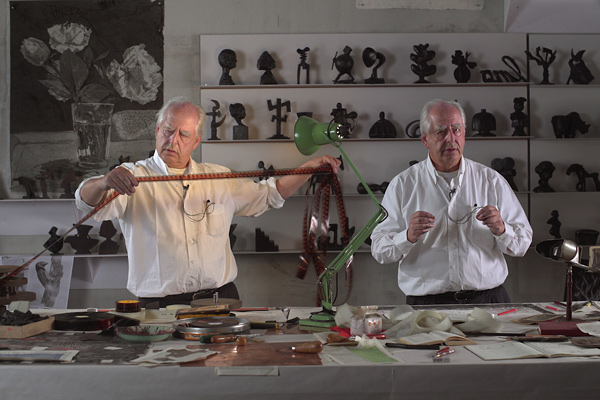
William Kentridge Studio
William Kentridge’s film series SELF-PORTRAIT AS A COFFEE POT
Presented by Koffler Arts, with work from the William Kentridge Studio
January 20 – March 8, 2026
Koffler Arts, Toronto
This winter, Koffler Arts transforms the Koffler Gallery into an immersive experience inspired by William Kentridge’s SELF-PORTRAIT AS A COFFEE POT. The series of nine 30-minute films, shot in Kentridge’s Johannesburg studio during and in the aftermath of the COVID-19 pandemic, offers an intimate view of the artist at work. Visitors are invited to take off their coats, enjoy coffee or tea with a biscuit, and settle into a cozy space inspired by elements of Kentridge’s studio, designed by celebrated theatre designer Teresa Przybylski.
“Filming began in the first lockdown and the studio mimicked the closed spaces of COVID, but the studio is also an enlarged head, a chamber for thoughts and reflections where all the drawings, photos and detritus on the walls become these thoughts,” says Kentridge.
We witness Kentridge drawing and painting, pacing the floor and grappling with the ever-present monster of creative doubt. By a clever sleight of hand, Kentridge has filmed two versions of himself, transforming this otherwise inner monologue into a robust dialogue about art, work, memory, history and time. And the coffee pot, described by Kentridge as “an indirect metaphorical self-portrait,” is ever-present.
Przybylski researched Kentridge’s style and studio, props and accessories, to enhance the experience of viewing the films. “Many years ago, I saw his exhibition in Milano, and it left me with a sense of wonder and admiration,” says Przybylski. “The images had a lasting and meaningful impact. His openness to new ideas, incorporation of drawing, film and animation, his ability to manipulate the scale of things, and his masterful command of the art of drawing, are among many things that fascinated me in this presentation.”
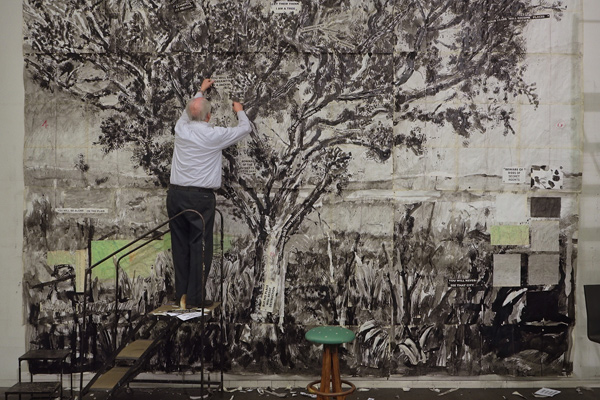
Still from SELF-PORTRAIT AS A COFFEE POT film by the William Kentridge Studio
About William Kentridge
William Kentridge (b. 1955, Johannesburg, South Africa) is internationally acclaimed for his drawings, films, theatre and opera productions, and collaborative practices to create works of art that are grounded in politics, science, literature and history, and which always maintain a space for contradiction and uncertainty.
Kentridge’s work has been seen in museums and galleries around the world since his first survey exhibition in 1998 at Palais des Beaux Arts, Brussels, including the Albertina Museum (Vienna), Johannesburg Art Gallery, Musée du Louvre (Paris), Museum of Modern Art (New York), Norval Foundation (Cape Town), Royal Academy of Arts (London), Whitechapel Gallery (London), Zeitz Museum of Contemporary Art Africa (Cape Town), among others. He has participated a number of times in documenta (Kassel) (2012, 2002, 1997) and the Venice Biennale (2015, 2013, 2005, 1999).
About Teresa Przybylski
Teresa Przybylski is an architect and a theatre designer, known for her designs in theatre, opera, dance and film. Her work in theatre was awarded with five Dora Mavor Moore Awards. She is the recipient of two Gemini Awards for Film and Television Production Design, and is a member of the Royal Canadian Academy of Arts and Associated Designers of Canada.
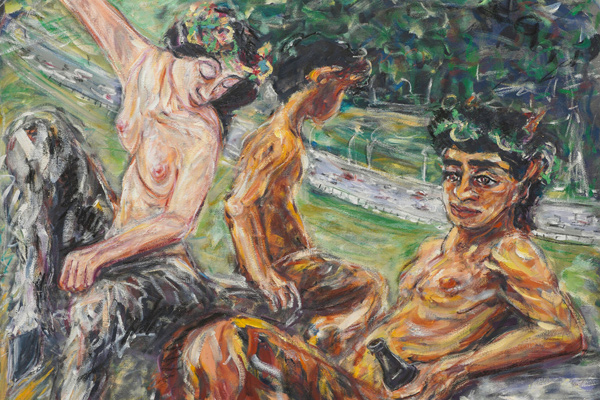
Sybil Goldstein, Satyr Family Overlooking The Don Valley (1984)
Sybil Goldstein / URBAN MYTHS
January 20 – March 1, 2026
Koffler301
In Koffler301, our new gallery space, we celebrate the legacy of Sybil Goldstein, one of the founding members of Toronto’s ChromaZone Collective, curated by David Liss. URBAN MYTHS offers a rare opportunity to encounter the full breadth of Goldstein’s vision and includes many artworks never seen by the public until now. Since her unexpected passing in 2012, her work has been held in storage by her family in Toronto. In this unique viewing experience, visitors will have the opportunity to take home one of her original artworks once the exhibition closes.
“By bringing her long-hidden pieces into public view, the exhibition not only honours Goldstein’s remarkable legacy but also reaffirms her place within the cultural history of Toronto and the wider artistic movements that shaped her generation,” says Liss.
Sybil focused on urban culture, people on street corners going about their daily lives, as well as the interiors of bars and malls; the city’s skyline; and parks, and abandoned spaces. Many scenes were populated with mythological creatures: angels, satyrs, and ghosts. Across expansive surfaces of canvas, paper, or small studies on board, her energetic line, and her sometimes impatient and rough brushwork reveals an artist striving to capture the fleeting moments surrounding her.
She was a founding member—alongside Andy Fabo, Oliver Girling, Rae Johnson, H.P. Marti, Tony Wilson and Brian Burnett—of ChromaZone Collective (1981–86) that organized exhibitions and events united by their embrace of a figurative Neo-expressionist tendency emerging internationally.
Sybil Goldstein (b. 1954, Montreal; d. 2012, Toronto) was a Toronto painter, curator and educator. She studied art at Dawson College and The Nova Scotia College of Art and Design. She moved to Toronto in the early 1980s where she became a founding member of the ChromaZone Collective, Loop Gallery and an active member of Red Head Gallery in Toronto.
About Koffler Arts
Koffler Arts is a multi-disciplinary arts platform that celebrates Jewish artistic voices within a diverse and exploratory framework of contemporary expression. Firm believers in the inherent value of art as an essential vehicle for creating meaning and providing enjoyment, we strive to affirm our collective need for the compass and connection offered by the artist’s eye upon the world.

Koffler Arts
Youngplace, 180 Shaw Street
Toronto, ON M6J 2W5
kofflerarts.org
admin@kofflerarts.org
Facebook | Instagram
Accessibility:
Koffler Arts is fully accessible. For more information, visit here.
Image Descriptions:
1. William Kentridge appears twice in the same image. On the left, he examines a strip of film, on the right, he looks directly at the camera.
2. Kentridge stands on a staircase in his studio, attaching a sign to a charcoal tree.
3. Three members of a satyr family look in different directions.
Related Content
Katherine Takpannie: Every Now and Then I Get a Feeling
Grant Heaps: Where I Sit and Put on My Shoes