Sean Lee on Nuit Blanche 2025
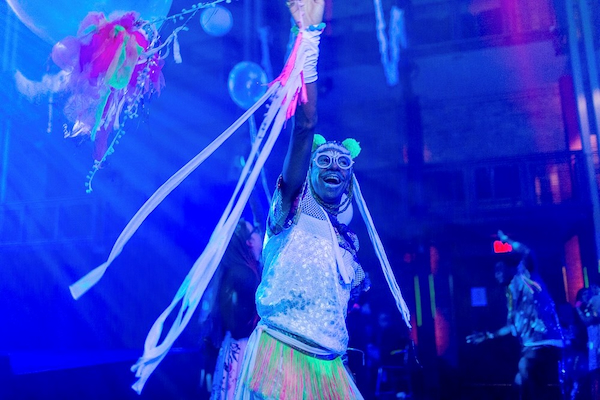
Tangled Art + Disability, The Nuit Blanche Remote Access Hub, 2025 (photo: Michelle Peek Photography; courtesy of The Centre for Art & Social Justice at the University of Guelph)
Every fall, Nuit Blanche transforms Toronto into a citywide festival of contemporary art. For one art-filled night, public squares, galleries and sidewalks come alive with installations and performances. Yet for many disabled community members, this transformation has historically been out of reach. Streets, subway stations, and sidewalks become difficult or impossible to navigate. The scale of the event – designed to overwhelm the senses – amplifies barriers rather than dismantling them. What is celebrated as a moment of collective belonging often operates as an engine of exclusion.
Tangled Art + Disability’s project for this year’s festival, the Remote Access Hub, is a deliberate intervention into this dynamic. Rather than treating accessibility as an afterthought or compliance measure, Tangled reframes it as culture itself: an aesthetic, a methodology, and a form of collective world-making. The Remote Access Hub invites audiences to experience Nuit Blanche from anywhere, in real time, through crip modes of storytelling and connection.
Beyond Compliance Culture
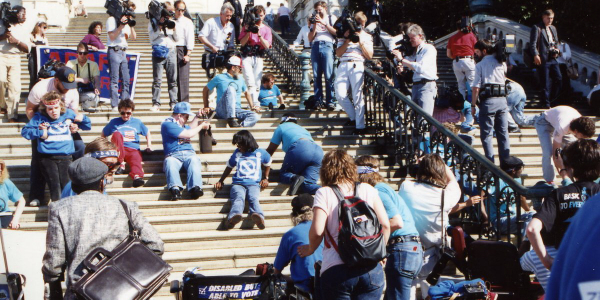
The Capitol Crawl, Americans with Disabilities Act demonstration, March 12, 1990
Large cultural festivals often treat accessibility as an afterthought: a ramp here, an interpreter for one event, a single wheelchair accessible washroom somewhere in the space. While welcome, these piecemeal efforts reinforce what many call “compliance culture” – where access exists only to satisfy regulations, not to reshape the culture of participation.
But disabled people have never waited quietly at the threshold. From activists taking sledgehammers to sidewalks to create curb cuts in the 1970s, to the Capitol Crawl of 1990 that pressured legislators to pass the Americans with Disabilities Act, access has always been hacked into existence. This hacktivist spirit – refusing erasure by bending the world to fit disabled life – is at the heart of disability culture
Crip Hacking the City
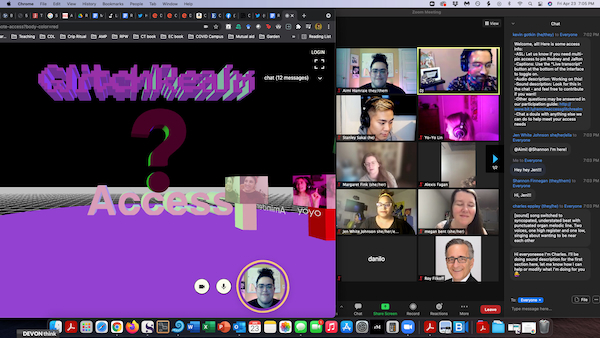
Kevin Gotkin, Remote Access: GlitchRealm, April 2021, remote access party
Remote Access Parties, first developed by Kevin Gotkin and Critical Design Lab, emerged in this lineage as crip nightlife experiments. They made access playful, sensory, and participatory. Tangled extends this model to Nuit Blanche, not as a supplement to the festival but as crip hacking: a way of remaking the city through disabled aesthetics of access.
Tangled’s Remote Access Hub builds on this lineage. Instead of treating access as invisible infrastructure, it centers it as the creative force of the night. Lead by disability artists from our community, these correspondents will be accompanied by Tangled staff and audio describers to create a description-rich experience of the festival.
An Access Intervention
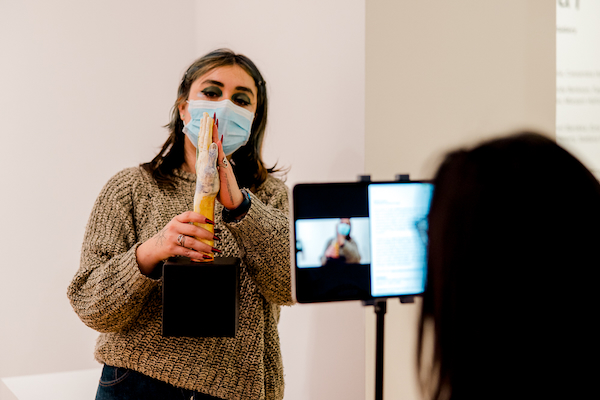
Participation guide for Tangled’s #CripRitual exhibition, 2022 (photograph: Michelle Peek; courtesy of Bodies in Translation: Activist Art, Technology, and Access to Life)
Hosted on Zoom, the Remote Access Hub becomes its own art installation: part broadcast, part gathering place, part experiment in disability-led culture-making. The event will feature ASL interpretation, captioning, and a participation guide that helps attendees engage collectively, no matter where they are.
At its heart, Tangled frames this as an access intervention. It interrupts the usual script of festivals, where access is sidelined or outsourced. Instead, access is staged as art itself, foregrounded and celebrated.
This reframing draws directly from disability justice principles. Access is not just about individual accommodation, but about collective care. The Remote Access Hub resists the myth of independence by affirming interdependence: disabled people thriving together, building culture out of shared needs.
Community, Care, and Resistance

Mia Mingus
The Remote Access Hub is more than a livestream. It is a gathering in the spirit of access intimacy, a term coined by Mia Mingus to describe the comfort of shared understanding when access needs are met. For disabled audiences, the hub offers a rare space where access isn’t begrudgingly “granted” but joyfully co-created.
There will be music, conversation, and crip time – that slow, elastic sense of pacing that resists productivity culture. There will be delight in the act of translating a city through disabled bodies and minds. And there will be solidarity in the recognition that access is always political, always about who gets to belong.
By centering disability community, the Remote Access Hub is about resisting the way ableism isolates us all. It reclaims art not as something to be consumed, but as a space for care and resistance. Access here is not charity. It is artistry. It is organizing. It is culture-building.
Translating the City Otherwise
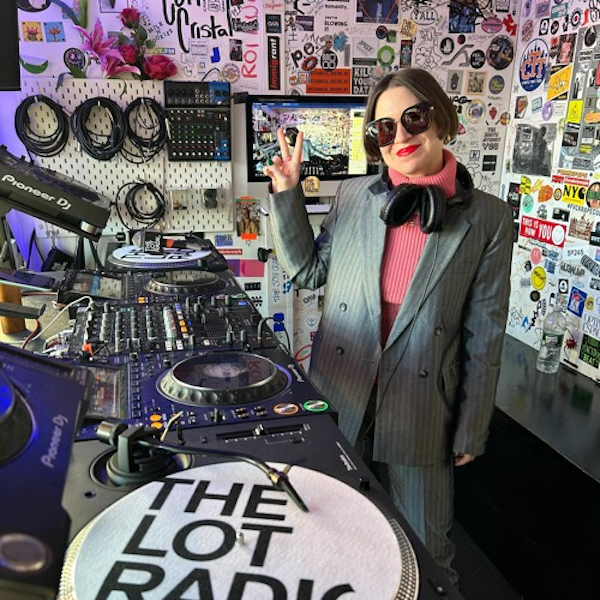
Remote Access Hub participant DJ Crip Time (Stefana Fratila)
This year’s Nuit Blanche theme is Translating the City. Tangled asks: how do disabled people translate a city that so often excludes them?
The Remote Access Hub offers one answer. It crip-hacks barriers into openings, turning the very act of translation into an art form. It insists that access is not only possible but beautiful, generative, and fun.
In doing so, Tangled extends an invitation and a challenge. What if all cultural events began with access at the center? What new forms of art and community might we create together?
In the end, Tangled’s project is not simply about watching Nuit Blanche remotely. It’s about experiencing another kind of city altogether – one built on care, creativity, and disability justice. A city that disabled people have always imagined, and one we can all learn from.
Sean Lee is the Director of Programming at Tangled Art + Disability in Toronto.