Jana Sterbak at Esker Foundation, Calgary
By Marsel Reddick
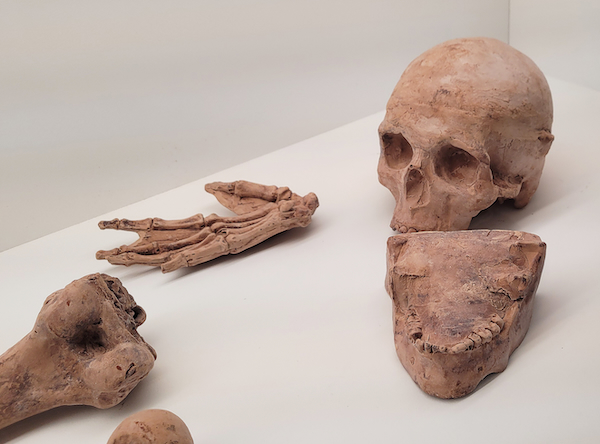
Jana Sterbak, Catacombes (Catacombs), 1992, chocolate (courtesy of the artist)
How can two opposing phenomena coexist in a single form? This question is at the core of Jana Sterbak’s practice and is seen in motion (quite literally) in Dimensions of Intimacy, a comprehensive survey exhibition that opened recently at the Esker Foundation.
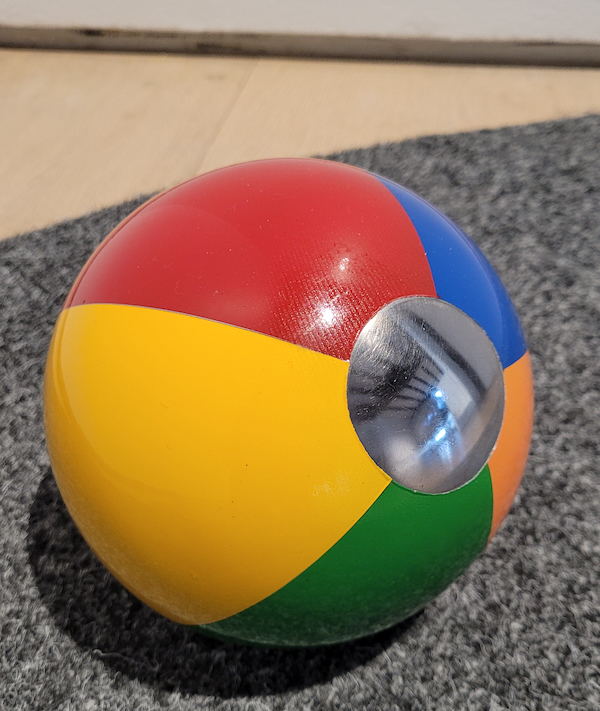
Jana Sterbak, Condensed, 1979 (reissued 1996), painted lead ball (courtesy of the artist)
The first work viewers encounter on entering the gallery space is a small lead beach ball atop a puddle-shaped rug. Condensed (1979) plays with contradiction in its scale and heaviness, which can nearly be felt by imagining the effort in trying to pick it up. To the right of the exhibition title wall is a vitrine filled with curious objects including a granite die. Dicey (2023) proposes a gesture – a roll for an answer – but its weight revokes that potential, leaving it in a constant state of possibility. To either side of the vitrine, sets of glass containers suggest a similar impossible potentiality; nestled within one another, they cannot be separated without risk of breaking. The fantastical nature of disparate concepts metamorphosing within singular forms can be discovered throughout the exhibition.
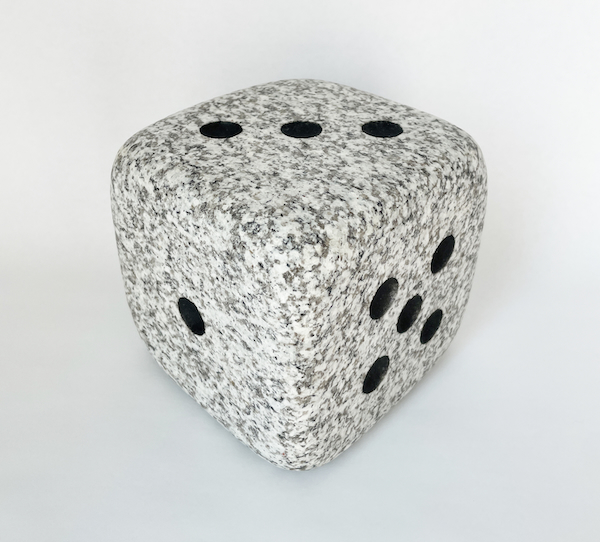
Jana Sterbak, Dicey, 2023, granite (courtesy of the artist)
In her artist’s talk at the Esker last Saturday, Sterbak explained that her work is less about ideas and more about “sensation congealed into objects.” Another vitrine contains a disassembled human skeleton; the aged bones realistically cast in chocolate. The material choice of chocolate creates a disturbing sensory experience – the idea of consuming human bones, perhaps even a desire to do so. According to director/curator, Naomi Potter, the thirty-plus year old bones of Catacombes (1992) still smell like chocolate, though the viewer must imagine the smell through the glass. Imagined sensations are evoked as well with I Want You to Feel the Way I Do… (The Dress) (1984-1985), an electric wire dress which gallery attendants will activate upon request for about forty seconds. The viewer, standing in the air-conditioned gallery cannot feel the heat, yet staring into the red-hot coil silhouette evokes a sensation of burning. The violence of intimacy and desire are major themes throughout Dimensions of Intimacy, with many works defying standard museum rules of “no touching” by reaching out to our other senses such as taste, temperature, and sound.
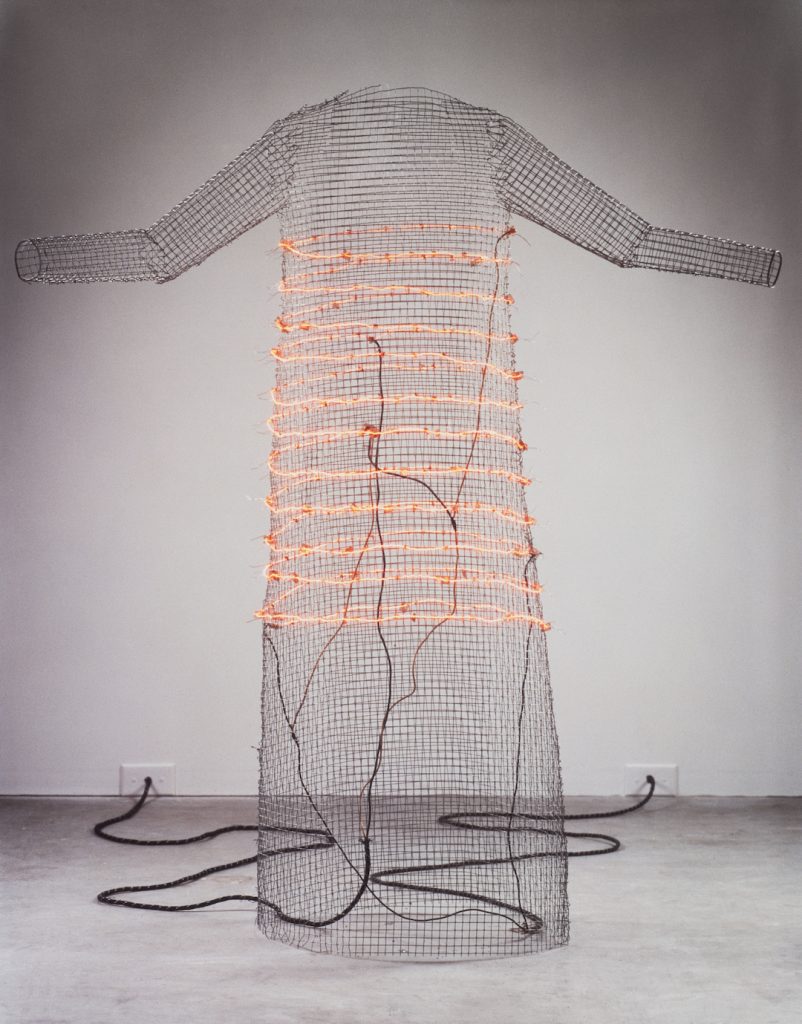
Jana Sterbak, I Want You to Feel the Way I Do … (The Dress), 1984-1985, live uninsulated nickel-chrome wire mounted on wire mesh, electrical cord and power, with slide-projected text (courtesy of National Gallery of Canada; photo: Robert Keziere)
Sterbak says repulsion and attraction are essential to successful works of art – if it’s too repulsive, no one will want to engage with it, but if it’s too attractive it becomes decoration. This dynamic is clear in Seduction Couch (1986-87), an electric couch which is responsible for the constant and jarring zap! zap! zap! noise emanating throughout the gallery. The exhibition brochure states, “If you touch this work you will receive a shock.” Viewers are warned, but are not instructed not to touch the work, thus left to negotiate the possibility for an act for which we know the consequences. This unusual freedom (to touch an artwork) evokes a need to act. While depictions and references to the body are common in Sterbak’s work, she claims her work is not about the body – it’s about power dynamics and the struggle for freedom.
Jana Sterbak: Dimensions of Intimacy continues until December 21.
Esker Foundation: eskerfoundation.com
The gallery is accessible.
Marsel Reddick is an artist and writer based in Moh’kins’tsis whose research explores identity, divination, materiality, trans history, magic, intuition, and affect.