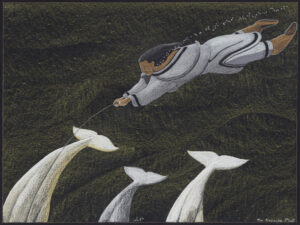
INTAC (International Art Collaborations)
Art can provoke new thinking in surprising and novel ways. It can jump beyond statistics and information to engage the imagination, challenge us, or spark hope. We suggest that cultural attitudes and societal habits lie at the heart of changes needed to address global issues such as climate change, social inequities, economic structures, the destruction of our natural world or migration challenges. Art can play a role in global sustainability by creating awareness and shifting entrenched patterns of thinking, expectations and behaviour.
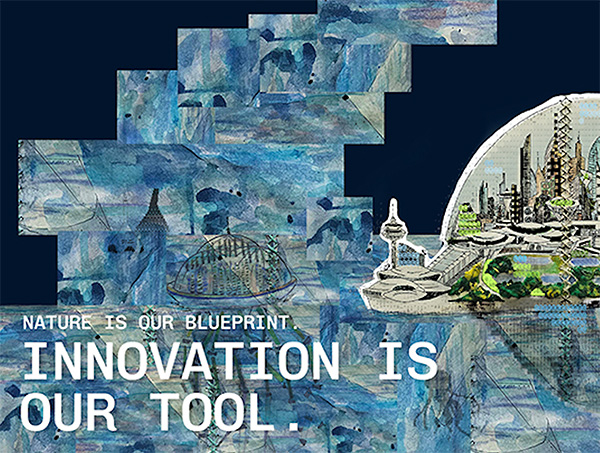
Arcology, Elizabeth Schaik, Kat Mendonca, Amrita Das, NID, India
INTAC Sustainability Jam 2025
July 16 – August 14, 2025
assemblage, Toronto
INTAC Sustainability Jam 2025 – From May 17 to June 14, 2025, nineteen participants from nine universities worked together online, collaborating in small groups to select and explore diverse issues related to building sustainable global futures. Peter Sramek from OCAD University in Toronto and Giselle Mira-Diaz from Indiana University Northwest (USA) were the core faculty facilitators.
Participating Universities:
OCAD University (OCADU), Toronto, Canada
Indiana University Northwest (IUN), Gary, Indiana, USA
Tampere University of Applied Sciences (TAMK), Finland
College of Dupage (COD), Glen Ellen, Illinios, USA
Autonomous University of Mexico State (UAEM), Toluca, México State, México
National Institute of Design (NID), Gujarat, India
University of Europe for Applied Sciences (UE), Berlin, Germany
Illinois State University (ISU), Normal, Illinois
Student Participants:
Elizabeth van Schaik, TAMK alumna, Finland; Kat Mendonca, OCADU alumna, Canada; Amrita Das, NID, India; Sachin Kumar, NID, India; Brisa Quevedo Jordán, UAM, México; Abigail Svitko, IUN, USA; Nola White, COD, USA; Gnat Djuras, IUN, USA; Badel Batu. UE, Germany; Balquir, UAM, México; Rindy Sutherland, ISU, USA; Vianée Anahil Garcia, IUN, USA; Felipe Sarmiento, OCADU alum, Canada; RJ Filsinger, COD, USA; Marco González, UAEM, México; Alivia Sarkar, NID, India; Daniela Duarte, UAEM, México; Fernanda Beltran Coss, COD, USA; Luis Muñiz, UAM, México.
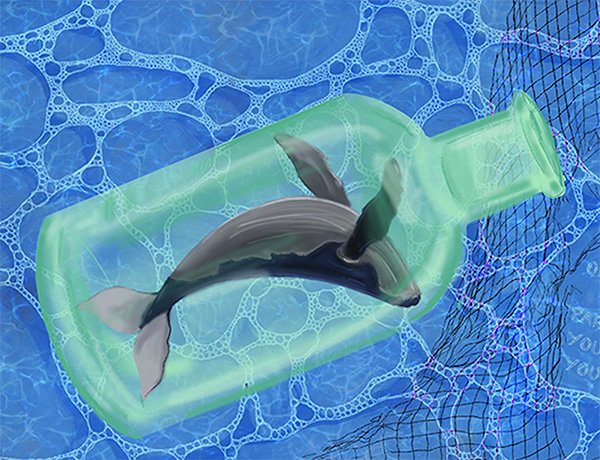
Pollution: The Experience of Whales, Vianée Anahil Garcia, IUN, USA
Education today is faced with the task of developing socially and culturally sustainable models in an era where the challenges are global in scope. For arts and culture facilitators questions arise around how to use online spaces to provide engaging international experiences for students and colleagues. How does one share and preserve distinctive cultures and creative contexts when connecting online? And how, on graduation, might arts and media students find a foothold in global economies of artistic production?
Since 2010, students and professors at multiple universities around the world have engaged in meaningful international experiences under the name International Art Collaborations (INTAC). Students work in many mediums, with a focus on photography, video, audio, text-based works, artist books and performance. These engagements have brought together universities located in Finland, Mexico, Canada, United States, Germany, South Korea, Japan and China.

For more information:
Website: intacnet.org
Documentation: sustainability.intacnet.org
assemblage
assemblage is a public-facing storefront space dedicated to the exhibition of emerging and established artists. assemblage embraces “liveliness”: our research and activities consider questions such as: how are we interconnected with our environment, communities, and non-human ecosystems? Knowledge sharing and dissemination take the form of workshops, exhibitions, publications, and seminars. Our goal is to remain fluid as we embrace complex issues, acknowledge entanglements, and foster inter- and cross-disciplinary practices.

assemblage
2015 Dundas Street West
Toronto, ON
assemblage-gallery.com
Accessibility:
assemblage is accessible. As a storefront gallery, works are viewed from the street.
assemblage acknowledges the ancestral territories of the Mississaugas of the Credit, the Haudenosaunee, the Anishinaabeg and the Huron-Wendat, who are the original owners and custodians of this land. We also acknowledge the Métis, Inuit, and Indigenous urban communities who share these lands.
Related Content
Images Festival 39th Edition: Tickets on Sale Now
Call for Submissions: Who is Your Self-ie Juried Photography Exhibition