Hidden Blackness: Edward Mitchell Bannister (1828-1901)
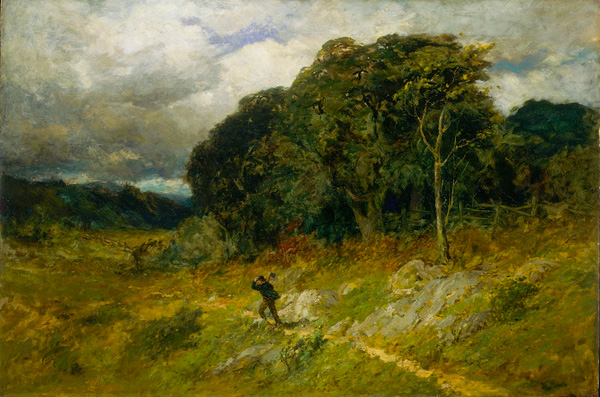
Edward Mitchell Bannister, Approaching Storm, 1886, oil on canvas, 102.0 x 152.4 cm, Collection of the Smithsonian American Art Museum, Gift of G. William Miller (1983.95.62)
Hidden Blackness: Edward Mitchell Bannister (1828-1901)
January 25 – April 6, 2025
Vernissage: Friday, January 24, 7:00 pm
Owens Art Gallery, Mount Allison University
Curator: Dr. David Woods
Organized and circulated by the Owens Art Gallery, Mount Allison University, and the Black Artists Network of Nova Scotia (BANNS)
Hidden Blackness is the first major exhibition of Edward Mitchell Bannister’s work ever presented in Canada—124 years after the artist’s death. Born in Saint Andrews, New Brunswick, Bannister was a self-taught, nineteenth-century, African American/Canadian painter of the Barbizon school known for pastoral landscapes and seascapes. In 1876, Bannister’s painting Under the Oaks (now lost) won the bronze medal (first place) at the Centennial Exposition Art Exhibition in Philadelphia, thus making him the first artist of African descent and the first Canadian to win a major art prize in North America.
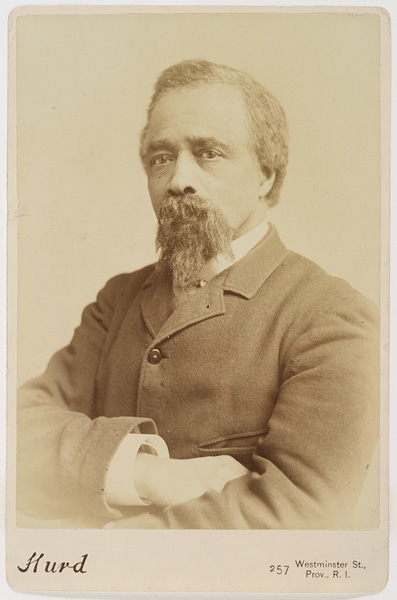
Gustine L. Hurd, Edward Mitchell Bannister, c. 1880, Albumen silver print, 14.5 × 10.3 cm, Collection of the National Portrait Gallery, Smithsonian Institution, Gift of Sandra and Jacob Terner (NPG.76.66)
The story of Bannister’s life and art—from his humble beginnings in New Brunswick to success in the United States—is a remarkable testament to the strength and conviction of his artistic vision. Born in Saint Andrews, Charlotte County, to Hannah Alexander, a Black woman from the town, and Edward Bannister Senior a native of Barbados, Bannister’s family lived in a segregated Black village colloquially referred to as Slabtown (now buried under the famed Algonquin Resort’s golf course). Bannister was orphaned by age sixteen and left in the care of Harris Hatch, a wealthy lawyer, merchant, and Registrar of Charlotte County, for whom the artist’s mother worked as a maid. Bannister and his brother, William, worked as farmhands for Hatch and lived in one of his barns. Bannister’s interest in art emerged early and there are accounts of his drawings appearing on the barns and fences of Hatch’s farm. Much of his early life in Saint Andrews was overshadowed by the limited job opportunities and racism that Black New Brunswickers faced. In 1850, Bannister and his brother moved to Boston, where they both worked as barbers and Edward eventually met Christiana Carteaux, a hairdresser, wigmaker, and entrepreneur of mixed African American and Narragansett heritage. Bannister married Carteaux in 1857, and she helped him pursue his lifelong dream of becoming a professional artist, first in Boston and later Providence, Rhode Island.
Hidden Blackness thus represents Bannister’s Maritime homecoming. Featuring loans from the permanent collections of the Smithsonian American Art Museum, the New Brunswick Museum, the Art Gallery of Nova Scotia, and the Beaverbrook Art Gallery, as well as the private collection of Marilyn Sandford, the exhibition will tour the Maritime region for a year, with presentations at the Confederation Centre Art Gallery (Charlottetown, PEI) and the Art Gallery of Nova Scotia (Halifax, NS). According to Dr. Woods, “Hidden Blackness will give the Canadian public its first glimpse of the creativity and excellence of Edward Mitchell Bannister’s artistry, while also providing an important opportunity to examine his early years in Saint Andrews, New Brunswick, as well as the life of nineteenth-century Black New Brunswickers in communities like Slabtown.”
This exhibition is organized and circulated by the Owens Art Gallery, Mount Allison University, and the Black Artists Network of Nova Scotia (BANNS). It was made possible thanks to funding from Mount Allison University (Marjorie Young Bell Fine Arts and Music Awards). PACART is the exclusive transportation provider of the exhibition.
We would like to acknowledge that the Owens Art Gallery, Mount Allison University, is located within the traditional territory of Mi’kma’ki, the unceded ancestral homelands of the Mi’kmaq. Our relationship and our privilege to live on this territory was agreed upon in the Peace and Friendship Treaties of 1725 to 1752. Because of this treaty relationship, it is to be acknowledged that we are all Treaty People and have a responsibility to respect this territory.

Owens Art Gallery
Mount Allison University
61 York Street Sackville, NB, E4L 1E1 • 506-364-2574
owens@mta.ca
www.owensartgallery.com
Facebook | Instagram | Vimeo
Monday to Friday, 10:00 am to 5:00 pm
Saturday and Sunday, 1:00 pm to 5:00 pm
Admission is Free
The Owens is partially accessible. The stairs from the entrance nearest the University Chapel have a handrail. There is also ramp access at this entrance, however, the ramp is steep. The stairs to the entrance off York Street have a handrail, but no ramp, and are covered with temporary wood treads. The main floor of the Owens is wheelchair accessible. Our second-floor gallery and gendered bathrooms are located in the basement and are not accessible. Two flights of stairs lead to each of these floors. LED lights are used throughout the building. The Owens welcomes guide dogs and other service animals. The closest accessible parking spaces are located on York Street across from the Owens. For detailed information on venue access, please visit our Accessibility page. If you would like to visit the Owens at a quieter time, or when all staff and visitors are masked, private visits can be arranged from 9:00-10:00 am on weekdays.
If you have any questions about your visit, please email owens@mta.ca or call (506) 364-2574.
Related Content
Katherine Takpannie: Every Now and Then I Get a Feeling
Grant Heaps: Where I Sit and Put on My Shoes