2024 Critics’ Picks – Part One
As per tradition, Akimblog has reserved the last two weeks of our publishing year to reflect on the past twelve months of art happenings in Canada. Our writers have selected the exhibitions that stuck with them long after they left the gallery. At a time of global turmoil when it’s hard not to spend every waking moment absorbed in politics, contemporary art can help us make sense of the chaos, respond to it, and relieve us of it. This list is a tribute to those possibilities.
Ogheneofegor Obuwoma in Vancouver
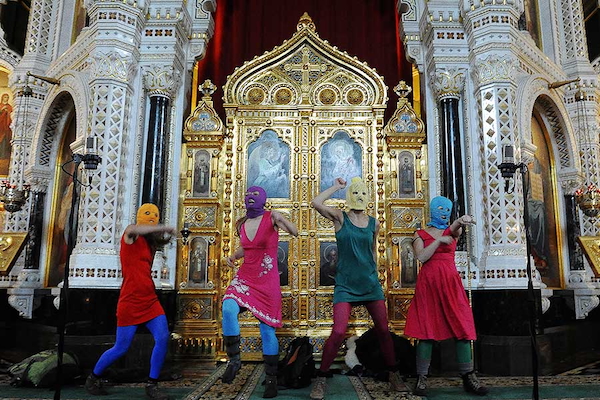
Pussy Riot, Punk Prayer, 2012, intervention at the Cathedral of Christ the Savior, Moscow (photo: Mitya Aleshkovs)
This has been an exceptionally strong year for the arts in Vancouver, featuring many outstanding exhibitions that reflect our situatedness in a continually polarizing world. In the next few years, the arts’ role as a tool for inquiry and activism will become even more of an ardent necessity, and I sense this need for radical thinking and hope already taking centre stage.
Velvet Terrorism: Pussy Riot’s Russia at The Polygon Gallery comes up for me as a sort of community pick for 2024. It was hard to find someone who hadn’t seen the exhibition during its run. The rebelliousness against state-sanctioned violence Pussy Riot embodied in their work (and even through the exhibition design) unsurprisingly captivated Vancouver. The Polygon has also returned with the newly renamed Lind Biennial, showing a fantastic roster of artists including Mena El Shazly, Karice Mitchell, Dion Smith-Dokkie, Parumveer Walia, and Casey Wei. They have presented us with an exciting and thoughtful group show that unearths conversations across many communities and amongst the artists in ways that complicate lens-based mediums.
I was also especially drawn to Pegah Tabassinejad’s Entropic Fields of Displacement at Vivo this year. She presented an eight-channel video installation of eight West Asian women from multiple countries walking to her recorded prompts. How women take up space and how their bodies are received by the simple act of walking was centred as a necessary inquiry, foregrounding a global issue of women’s public safety that poses the examination of women walking or “acting out” in public as a radical act worthy of close study. As always, I remain excited about the artistic possibilities and potential that will continue to unfold in Vancouver.
Levin Ifko in Calgary
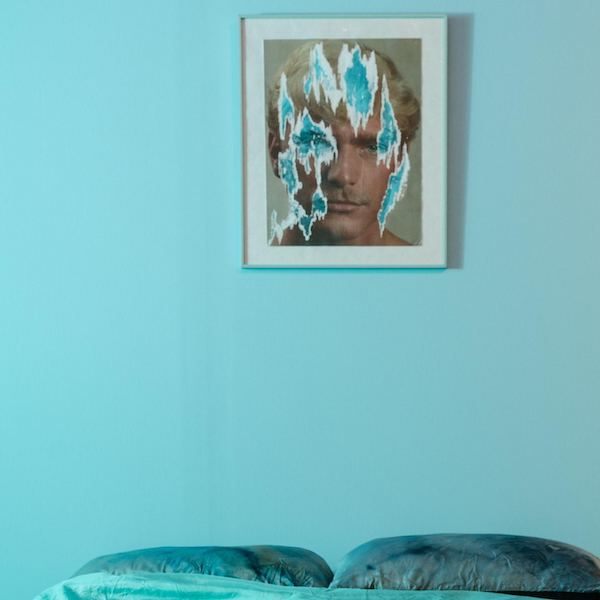
Ryan Danny Owen, Dirty Picture, 2024
This has been a truly great year in the city’s arts scene. In thinking back to all that, it feels especially tough to pick only a few highlights! With this in mind, I’ve chosen two exhibitions by local artists that I felt really lingered in my mind and heart as 2024 comes to a close.
The first is Wâsakâmapiwak Collective’s As the River Flows and the City Grows, which took place at the Lougheed House. Curated by Danielle Piper, the exhibition featured a breathtaking collection of wearables and beadwork. Each piece was so thoughtfully integrated into the building, installed everywhere from the walls and windowsills, to the desks and bedrooms. In doing this, the exhibition disrupted the colonial structure of the Victorian-era home, and emphasized the way Indigeneity is embedded in the site’s history and woven through its future. The launch party even featured a runway-style fashion show, and each artist modelled their wears while strutting through the halls of the heritage building.
Another personal favourite of the year was Ryan Danny Owen’s Dirty Picture, which was on view at TRUCK Contemporary Art Gallery this summer. This exhibition felt like a culmination for Owen, whose rubbings and textual interventions on pornographic archival material line the walls of the gallery. These works surround Owen’s Blue Fantasy Motel, an installation that immerses the viewers in an imagined queer sexual space. From the way I was deeply drawn into this blue universe, to the events the gallery hosted, such as the drag show that took place in Owen’s motel room, I can’t remember the last time I visited a gallery so often during a single exhibition!
There has also been a really incredible breadth of arts programming blooming this year, such as the community hub The Alcove Arts Centre for the Arts, Calgary Arts Development’s inaugural Art Bus Program, and Norberg Hall’s Birkenstock Customization Station. I admire how these projects (alongside many more) especially connect artists to interdisciplinary creators and much broader communities of art-lovers.
I’d also like to shout out the Esker Foundation, particularly the milestone exhibition Black Drone’s in the Hive by Deanna Bowen, and the comprehensive group exhibition Constellations: Racial myths, land, and labour, curated by Su-Ying Lee. Before the end of the year, I will lastly highly recommend seeing Marigold Santos and Rajni Perara’s Efflorescence/The Way We Wake at Contemporary Calgary – a beautiful show with a pairing of artists that was meant-to-be!
Terence Dick in Toronto
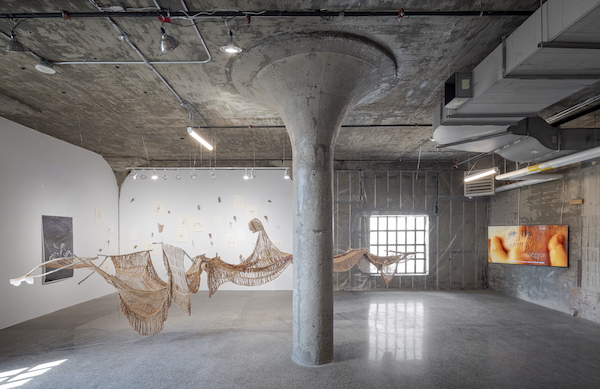
Cristina Flores Pescorán, Acariciar el corazón del hueso (Caressing the heart of the bone), 2023-2024, installation view at the 2024 Toronto Biennial (photo: Toni Hafkenscheid)
Way back in the aughts when they first held community consultations about starting up a Toronto biennial, I was initially skeptical (which is, admittedly, my go-to response for everything – I am a critic, after all). It felt like the age of biennials had already peaked. The big ones had been around forever, and the new ones had crowded the scene. There was even a fake Caribbean Biennial care of Maurizio Cattelan to mock the pretensions of this overloaded contemporary art endeavour, and a small cadre of “biennial artists” who seemed to be included in every second one, schlepping their spectacular installations from one corner of the world to another without much of any sense of where they were at any moment. Toronto was going to be a late-to-the-game bandwagon-jumper when the band and wagon had already jumped the shark.
But then the game changed. The era of art stars ended. The usual suspects stopped popping up, and the role and reward of something like a biennial shifted radically. For someone whose formative adult art-going experiences were in the late-nineties (starting with the 1999 Carnegie International, which, truth be told, isn’t a biennial, but it’s got the right vibe and check out the list of artists), the new world (pun intended) was disorienting. Who were these artists (and curators) and what was I looking at? Where was their art coming from – not just geographically, but conceptually? The globalist frame that I was used to had dropped away. It made for a disorienting experience that I’ve been wrestling with for the last half decade or so, and I felt it again at this year’s Toronto Biennial.
I was more than willing to accept this as a “me problem” and also intrigued by the challenge to articulate my response, but then, just last month, Dean Kissick in his polemical essay The Painted Protest for Harper’s Magazine gave it the longform treatment. His personal history has a lot in common with my own, and his nostalgia for the “good old days” is something I too wrestle with, but his conclusions didn’t land right with me. I’ve always been more of a tree than a forest art critic, and I got into this game because I liked being knocked off centre. I try not to go to an exhibition knowing what I like; I like to have to reconsider my own expectations of what I value and what is out there. This year’s Biennial did that again, and, like all good art, I can’t stop thinking about it.
Jon Claytor on the East Coast
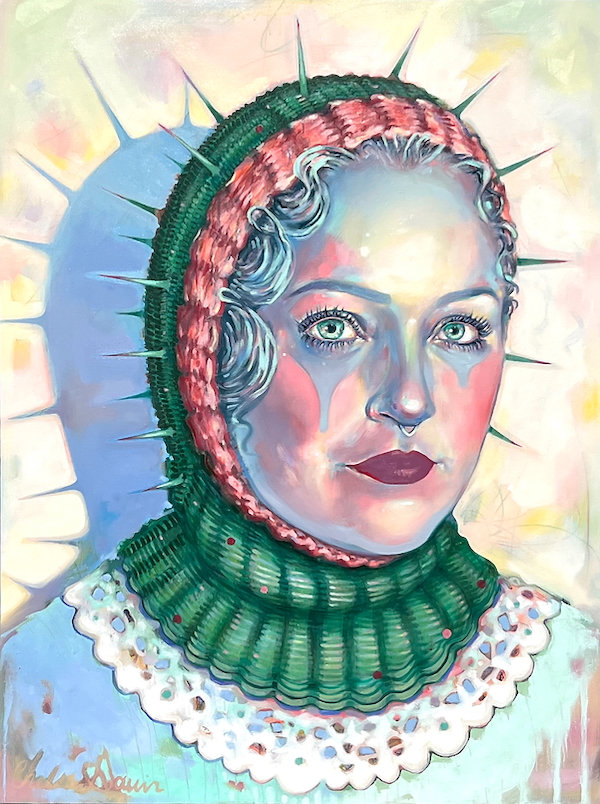
Chelsea Gauvin, Cap of Thorns, 2024, oil on canvas
There was an emphasis on colour, light, and the tactile in the exhibitions I reviewed this year. Sara Caracristi’s paintings full of saturated greens, purples, and pinks illuminated personal sanctuaries at Katzman Art Projects. Andrea Mortson and Paul Henderson’s hand-cut collages combined retro, Disneyesque colour schemes with unsettling imagery at The Blue Building. And Jerry Evans filled Owens Art Gallery with his personal video montages and prints spanning time and place with a soft palette and a human touch. But there were also two painters from Moncton that I did not get a chance to write about: Chelsea Gauvin and Jared Betts really stood out in this landscape of personal and evocative work.
Gauvin’s paintings at Apple Art in Moncton breathe a soft luminosity that ironically conceals a dark and mysterious heart. In Cap of Thorns she portrays a young woman in the quietest blues and pinks who is, on a closer look, clearly in pain. Her work leads us to question assumptions about how we perceive those around us.
Then there were the vivid, glowing, pop melodies of Betts’s paintings at Katzman Art Projects. These paintings also play a duplicitous game. Behind a neon and pastel palette illustrating recognizable pop images, he has concealed rough, brash, and emotional abstraction. This disconnect between image, colour, and technique asks the audience to reevaluate the artist’s personal connection to the imagery or lack thereof.
Both artists ask us to hold two realities at once as an aesthetic reaction collides with a visceral one to create a third meaning that leans towards the personal and emotional in a subtle way. These two shows make a good case to take note of the vibrant world class painting scene emerging in Moncton in 2024.