Call for Pitches – BlackFlash Magazine Issue 42.1: Traces
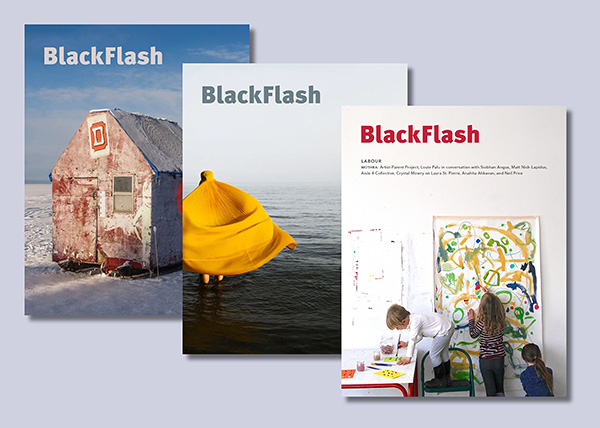
BlackFlash Magazine issues 40.3, 41.1, and 41.2.
Call for Pitches for “Traces” BlackFlash Magazine
Issue 42.1 (Spring 2025)
Deadline: December 10, 2024
What continuity can be traced across an artist’s career? What does it mean to leave a legacy? In artwork, a trace might be an influence, a material manifestation, documentation of an event, or an underlying sensibility. A trace might mark the passage between an original and a copy? It might be the elements of an early draft that linger in the finished product? Traces exist in the space between presence and absence—recording memory, and indexing a past event.
Freud’s metaphor of the magic slate, a toy where impressions linger in the deepest layer, suggests how perception and the subconscious intersect. How does the interplay between perception and the subconscious reveal itself in art criticism? What traces of labour—from studio assistants, fabricators, and preparators—persist within an artwork or exhibition? Where can we locate the artist’s trace? How does technology influence the lifespan of a work’s material integrity, meaning, and accessibility? What can we learn from tracing the histories of plundered museum collections? How do curators weave connections between artworks to reshape art history or challenge prevailing perceptions? In what ways does colonialism erase the traces of Indigenous cultures? What endures and what is lost in our collective memory?
For this issue, we invite contributors to creatively explore the theme of traces. Traces can take many forms and be interpreted from a variety of perspectives. They might reside in memory, material, style, artistic movements, landscapes, or institutions. Possible topics include career retrospectives, artistic legacies, engagement with archives and collections, invisible labour, interpreting artwork, obsolescence, earth art, extraction, printmaking, conservation and decay, forgery and bootlegs.
Keywords: retrospective; legacy; index; history; memory; body of work; family; lineage; documentation; ecology; extraction; scars; trauma; remediation; flagging; archive; palimpsest; institutional memory; impression; echoes; shadows; marks; influence; leftovers; memory; perception; subconscious; print; copy; reproduce; bootleg; patina; waste; trash; posterity; conservation; ephemera(l); evidence; impact; maps;
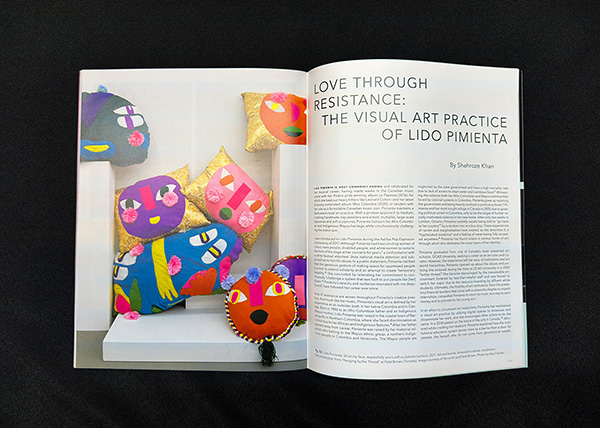
BlackFlash Magazine issue 39.2, pages 52-53.
How to Submit
Pitches for features, conversations, artist profiles, and artist projects will be accepted until December 10, 2024. Send pitches to submissions@blackflash.ca with the subject line 42.1 PITCH.
Your pitch should be under 250 words and provide a concise summary of your topic and approach. Explain why you’re the right person to write on this subject. If it’s a topic that’s been widely covered, highlight your unique critical perspective. The pitch should reflect the style and tone of your intended piece, giving a clear sense of your authorial voice. Please include an estimated word count and any relevant hyperlinks.
If you have recent writing samples (published or unpublished) that you would like us to consider, you can include them as links (to publications or your website), or as .pdf attachments.
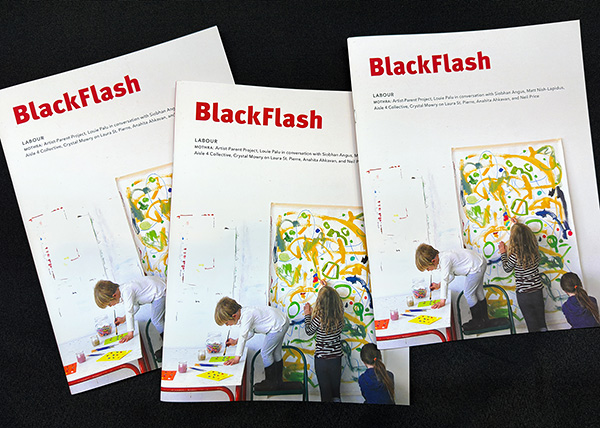
BlackFlash Magazine issue 41.2. Cover image features documentation of a MOTHRA residency, October 2019. Photographer: Sarah Cullen.
To familiarize yourself with the different kinds of texts we publish, please take a look at some of our recent publications. In our current issue, 41.2 “Labour” (Fall 2024), contributors reckon with these varied dimensions, tropes, traps, and gaps in the representation of labour from multiple perspectives. Featuring writing and artwork from Anahita Akhavan, Matt Nish-Lapidus, Crystal Mowry, Laura St. Pierre, Aisle 4 Collective, Sarah Cullen, Neil Price, Louie Palu and Sioban Angus. Subscribe today to start your subscription with this issue of BlackFlash.
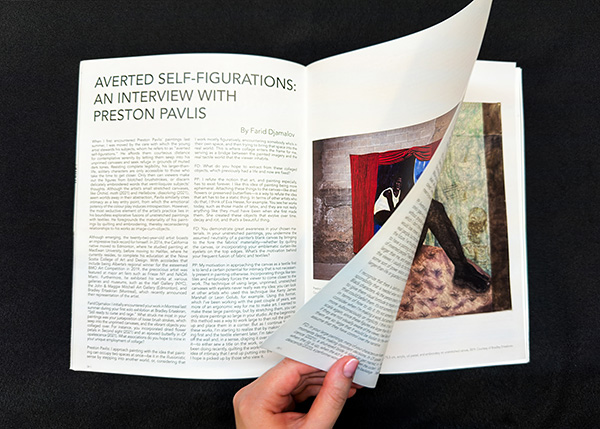
BlackFlash Magazine issue 39.1, pages 36-37.
Pitch Formats
If you have an idea for a submission that doesn’t neatly fit into one of our outlined formats below, pitch us anyway! Just be sure to give us a sense of what format or genre you will be exploring in your contribution.
Features: A 2,000-2,500 word text on a critical theme in contemporary art and culture, exploring urgent topics, under-explored histories, and objects of fascination you haven’t seen written about elsewhere. Writer’s fee: $1,000
Recent features we love include:
- Belinda Kwan’s reflections on digital access and disability justice in new media art and arts administration.
- Neil Price’s consideration of Black art and the natural world.
- Michael Peterson’s essay on the legacy and impact of Saskatoon’s Red Shift Gallery.
Conversations: A 2,500-3,000 word conversation between you and an artist, writer, or organizer, delving into their practice or a mutually shared topic of interest, including a brief introduction by the interviewer. Writer’s fee: $750.00. Interviewee honorarium: $150.00
Excellent recent interviews include:
- Luther Konadu in conversation with Leonard Suryajaya about their expansive, theatrical photographic practice.
- Farid Djamalov in conversation with Preston Pavlis on the contested politics of self-figuration.
- Kay Slater in conversation with Q Lawrence, one of the disability activists organizing to fight the MAID (Medical Assistance in Dying) legislation.
Artist Profiles: Introduce readers to a contemporary visual artist in a 1500 word text. Writer’s fee: $600.00
Recent artist profiles include:
- Shahroze Khan considers the work of Lido Pimienta.
- Cole Thompson examines one of Sean Weisgerger’s paintings.
Artist Projects: Showcase your studio practice and research in concert with the theme. Here, the portfolio of images takes the starring role. Projects can include 500 words plus a portfolio of images to fill up to six pages. Artist’s fee: $450.00
Recent artist projects include:
Instagram @blackflashmag
Facebook @bfmagazine
BlackFlash is proudly published, designed, and disseminated in Saskatoon, Saskatchewan, and is dedicated to presenting critical opinions, urgent issues, and innovative ideas about divergent artistic practices from across Canada, the United States and beyond.
Related Content

Call for Submissions – Unsilenced Stories: Art as Witness in Health Research

Call for Expressions of Interest: Public Art in Carnaby Park, Town of East Gwillimbury