Tyler Bright Hilton: If I Were You
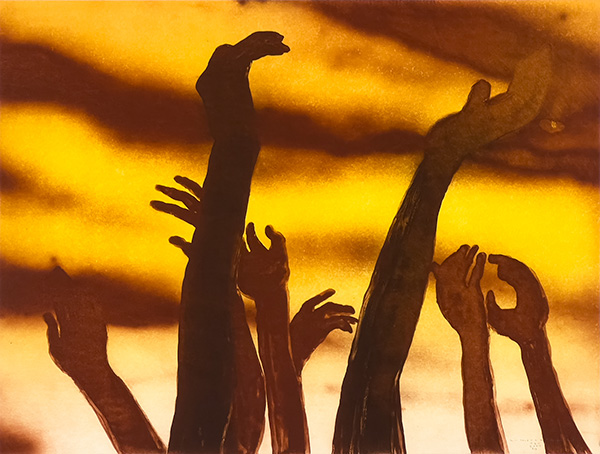
Tyler Bright Hilton, Your head’s a bad neighborhood, 2024, photopolymer gravure, edition of 5, 16.5″ x 22.5″
Tyler Bright Hilton
If I Were You
November 15 – December 20, 2024
Opening Reception: Friday, November 15, 6 – 9pm in-person | RSVP here
Smokestack Gallery, The Cotton Factory, Hamilton
If I Were You presents a solo-exhibition by Tyler Bright Hilton. Collaboratively produced during Hilton’s Analog Printmaking Residency with Smokestack’s analog printmaker, Laine Groeneweg, the new series of photopolymer gravure prints on featured display represent a printmaking discipline entirely new for Hilton’s artistic practice. An accomplished practitioner of etching, exploration with photopolymer gravure offered Hilton an exciting expansion of mark-making and imagery possibilities. Developing from a recent series of etchings completed earlier this year, this new collection of works further amplify Hilton’s investigations into imagined realities and the limits of control.
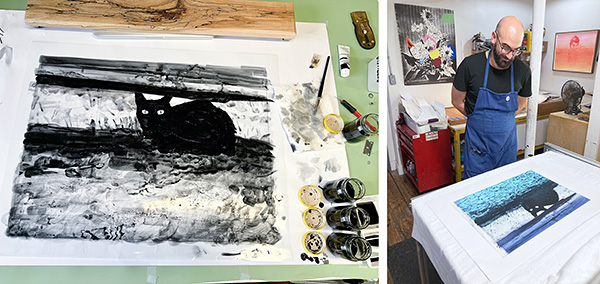
Tyler Bright Hilton in residence in the Smokestack Analog Studio, 2024
An interview between Hilton and Smokestack Gallery Director, Tara Westermann, follows:
Tara Westermann: From a focus on painting in the early days of your artistic practice, what initially compelled you to start working in intaglio printmaking?
Tyler Bright Hilton: Like every artist I had so much to figure out at the beginning. I’m equally interested in both formal pictorial elements and visual storytelling, which don’t always pair so easily, so narrowing things down to etching was a big help. It’s a little narrower than painting, but it’s equally bottomless.
TW: Why did photopolymer gravure become the medium of focus for your residency?
TBH: For a long time now, I’ve either been using fine tools to make metalpoint drawings and etchings or really crude tools like bamboo pens and cheap brushes to make paintings. I wanted to see what would happen if we braided those elements together, and working like we did (which was me making wash drawings or paintings directly onto transparent film to be exposed onto a polymer plate that was then printed by Laine in exactly the same manner as an etching plate) made that possible in an absolutely literal way. In this process the drawings I made function kind of like negatives in analog photography, so it would be like printing from a negative the exact same size as the print itself, allowing for an extremity of fidelity.
TW: How did the process uniquely support the imagery created in this body of work?
TBH: It’s a technical thing that of course translates into a content thing. A big part of what I love about printmaking is how it’s made by both hands and machines – for me, it’s like a handwritten diary that’s been translated into type; it cools it down. Traditional etching can’t show information inside a brush mark, but gravure can. It shows more of the handmade mark and in this way it brings something new to intaglio; it warms it back up. I like very dense art that presents vibrating opposites, so this was exciting.
TW: You and Laine have been working together for +10 years now. How has the collaborative experience through the making of this project been?
TBH: We love working together. He listens to what I’m looking for and I know his tastes too. With some works I realize I don’t exactly know what I’m after, and those are harder days because it’s like working with the lights off. Other times I’m totally clear and we get exactly what I want almost immediately. Sometimes Laine proposes an exciting solution that hadn’t occurred to me at all and those are really fun days. I think we’ve both gotten used to treating all of this as simply part of the process, like the whole thing is research and development. It’s work, but it’s also playing.
TW: Your professional practice to-date has been focused on the development of the expansive Minmei Madelynne Pryor series, though the images in this body of work look quite different than others you have created through the project’s development. What inspired the shift?
TBH: Well, it’s a large story divided into three acts that obliquely charts the maturing of my character. In the first two series, Minmei was still in her twenties and very self-involved. By the third act, which is where we are now, she’s less solipsistic and so we see a lot less of her. My new work isn’t so much about a single person marooned in her own mind, it’s more outward facing.
At the same time, I have this grand goal of always wanting my work to somehow articulate the feeling of thinking, to illustrate a sense of near-revelation, a moment when something difficult to articulate is glimpsed or intuited but not yet comprehensible, like a word on the tip of a tongue or a dream that feels full of significant insights but fades maddeningly from memory on waking.
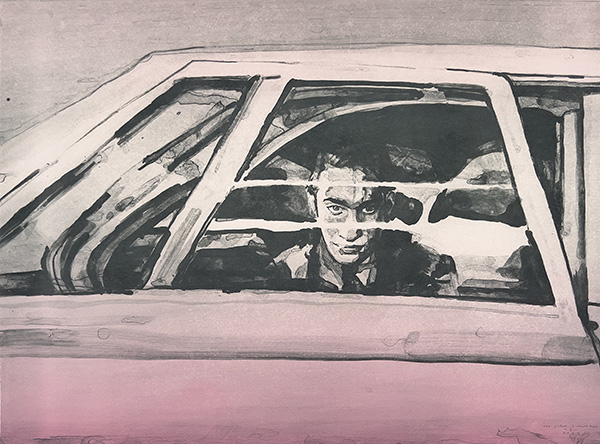
Tyler Bright Hilton, The surface is what’s there, 2024, photopolymer gravure, edition of 5, 16.5″ x 22.5″
Smokestack Gallery exhibits the work of artists who have produced their print projects in Smokestack’s Analog and Digital studios. The partnered operations between Smokestack Studios and Smokestack Gallery seek to establish a connection between the production of print works and their final presentation; to offer a greater understanding of the uniquely technical and creative processes involved in these specialized artistic disciplines.
Smokestack Analog Print Residencies and exhibition of artworks created by residency participants has been made possible with generous support from the Ontario Arts Council.
For more information:
Tel: 289.799.5088
gallery@smokestack.ca
www.smokestack.ca
@smokestack.studio
Gallery Hours:
Tuesday – Friday: 10am – 4pm or by appointment
Smokestack Gallery
270 Sherman Avenue N. Mill #213
The Cotton Factory
Hamilton, ON L8L 6N4
Wheelchair accessible (with assistance)

Related Content
Katherine Takpannie: Every Now and Then I Get a Feeling
Grant Heaps: Where I Sit and Put on My Shoes