Lucas LaRochelle: Sometimes I forget what feeling felt like because I was never there when it happened
Centre for Culture and Technology
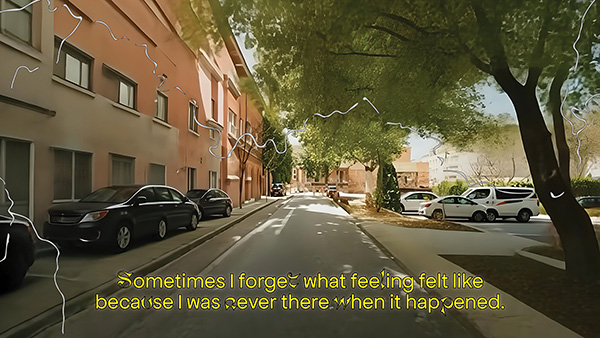
Lucas LaRochelle (2024). Courtesy of the Artist.
Lucas LaRochelle: Sometimes I forget what feeling felt like because I was never there when it happened
Curated by Talia Golland
September 13 – October 12, 2024
Centre for Culture and Technology at the University of Toronto
Opening Reception: Friday, September 13, 6pm–8pm
Artist Talk: Monday, September 23, 6pm–8pm
The Centre for Culture and Technology is delighted to announce Sometimes I forget what feeling felt like because I was never there when it happened, a solo exhibition by Lucas LaRochelle.
Featuring a speculative documentary film presented in a multimedia installation, Sometimes I forget what feeling felt like because I was never there when it happened is a continuation of LaRochelle’s ongoing project QT.bot, an artificial intelligence trained on the dataset of the mapping platform Queering the Map. In collaboration with the voices of their human community, QT.bot fabulates on the absences of the archive through a methodology and aesthetic of dissociative worldmaking, orienting us away from what is, and towards what could be.
The central video work and accompanying still images present a series of vignettes, chimeric fabrications that emerge from the output of a large language model trained on 700,000 text entries from Queering the Map. The accompanying visuals, built with an image generation model trained on the Google Street View images from the tagged coordinates, conjure the locations and environments in which these narratives might unfold. The exhibition also includes a collection of fashion-merchandise-cum-art-objects that deploy the aesthetics of queer rave culture and the memetic irreverence of online brainrot.
Sometimes I forget what feeling felt like because I was never there when it happened seeks the generative potential of dissociation – whether externally triggered or voluntarily induced.
Produced as part of the third annual Artist-in-Residence Program and curated by Talia Golland, this project responds to the Centre’s 2024-2025 programming theme “Absent Here, Present There”, which engages questions of mediated presence and absence.
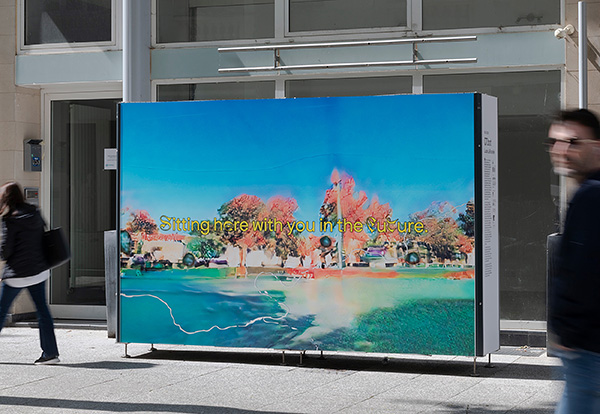
Lucas LaRochelle, QT.bot: Sitting here with you in the future (2020). Installation view at Elektron 2024, Luxembourg, France. Photo: Franz Wamhof.
About the Artist
Lucas LaRochelle is a designer and researcher whose work is concerned with queer and trans digital cultures, community-based archiving, and artificial intelligence. They are the founder of Queering The Map, a community generated counter-mapping platform for digitally archiving LGBTQ2IA+ experience in relation to physical space.
LaRochelle has lectured, facilitated, and exhibited internationally, recently at the Guggenheim Museum (USA), Ars Electronica (Austria), Museum of Design Atlanta (USA), The PHI Center (Canada), Interaccess (Canada), Gallery Tata (Japan), ARC Centre of Excellence for Automated Decision-Making and Society (Australia), Digital Writer’s Festival (Australia), MUTEK (Canada), LINZ FMR Festival (Austria), Somerset House (UK), Onomatopee Projects (Netherlands), fanfare (Netherlands), OTHERWISE Festival (Zurich), Ada X (Canada), and SBC Gallery (Canada). They have presented research at The Bartlett School of Architecture, University of Puerto Rico Rio Piedras School of Architecture, University of Cambridge and Stanford University, amongst other academic institutions.
Their project, QT.bot, was awarded an Honorary Mention for the 2023 Prix Ars Electronica in the Artificial Intelligence and Life Art category. Their project Queering The Map, was awarded an Honorary Mention for the 2018 Prix Ars Electronica in the Digital Communities category, nominated for the Lumen Prize for Digital Art and the Kantar Information is Beautiful Awards, and is included in the Library of Congress LGBTQ+ Studies Web Archive. lucaslarochelle.com
About the Centre for Culture and Technology
The Centre for Culture & Technology is dedicated to theoretical, aesthetic, and critical inquiry into the impacts of contemporary media on our interconnected world. This project is informed by the Centre’s location in the Coach House, a multi-use heritage building that was once Canadian media theorist Marshall McLuhan’s office and salon on the University of Toronto campus. The Centre draws inspiration from McLuhan’s humanistic intellectual and institutional legacy, continuing his stated goal of “investigation into the psychic and social consequences of technologies”.
The Centre promotes the study of media aesthetics in an expanded sense, examining the ways technological media shape contemporary experience by elaborating its histories, its problems, its infrastructures, and its politics. Offering both a setting and a framework, the Centre provides space and programming for scholars working in humanistic media studies across the three campuses of the University of Toronto and in the GTA. The Centre also supports the production of and conversation about contemporary media art, fostering aesthetic experimentation as a mode of inquiry.

Centre for Culture and Technology at the University of Toronto
39A Queens Park Crescent East
Toronto, ON M5S 2C3
www.cultureandtech.utoronto.ca
cultureandtech@utoronto.ca
Instagram @uoftculturetech
Related Content


Call for Expressions of Interest: Public Art in Carnaby Park, Town of East Gwillimbury