Angelo Muredda on The Squeaky Wheel: Canada
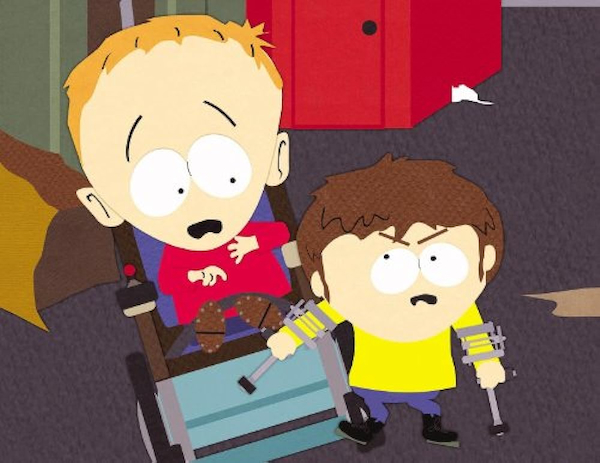
The first place I saw myself represented as a wheelchair user was on South Park. In the 2001 episode “Cripple Fight,” tensions boil over between South Park Elementary’s oldest-serving token disabled student, Timmy, a largely non-verbal wheelchair user, and new student Jimmy, a loquacious, crutch-using stand-up comedian popular for his inspirational aphorisms. After days of antagonizing Timmy with his obnoxious can-do spirit, Jimmy crosses a line, badgering him into playing a humiliating bit part in one of his routines. When Timmy refuses, the boys engage in a brutal bare-knuckle parking lot fight with the whole town watching, comically evoking the fist fight between burly men Roddy Piper and Keith David in They Live.
South Park is hardly a bastion of progressive disability representation, but watching this episode as a snarky disabled teenager in the early 2000s, I saw for the first time a satirical reflection of a real in-community dispute between different types of disabled people, the crip sourpuss and the inspirational sellout bound for middle management or politics. More importantly, I saw a recognition, absent from other onscreen representations of people supposedly like me, that being disabled in a world controlled by the nondisabled is not just the province of teary melodrama and inspirational biopics but of the darkest satire, in this case a sendup of the way ableist environments pit disabled people against each other, leaving them fighting for scraps of social capital.
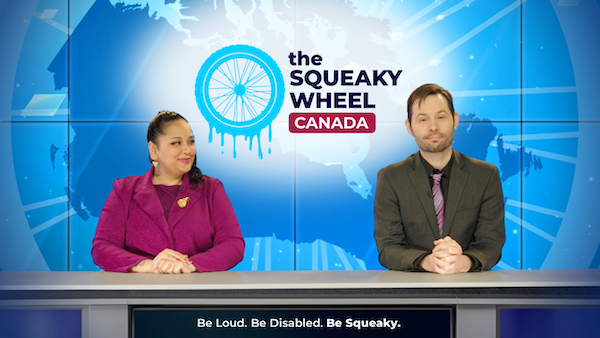
In recent years, disabled writers and performers have more frequently wielded rather than been the subjects of such dark humour. Launched last month, the webseries The Squeaky Wheel: Canada, a Daily Show-inspired comedy newscast for AMI+, is a good example. Based on Steven Verdile’s website The Squeaky Wheel, a disability-centric riff on The Onion, the series features hosts Graham Kent and Gaitrie Persaud and a rotating cast of disabled performers such as Wesley Magee-Saxton, Yousef Kadoura, and Courtney Gilmour, who offer a skeptic’s take on a range of contemporary cultural and political hot button issues affecting disabled Canadians, from AI assistive devices to accessible air travel. Along with fellow Canadian web series You’re My Hero, a show about a sarcastic wheelchair-using store clerk (played by creator, writer, and producer Sean Towgood) navigating the complexities of family, friendship, and romance, and Ryan O’Connell’s Special, his autobiographical Netflix series about dating while queer with cerebral palsy, The Squeaky Wheel: Canada recognizes the darkly comic potential of disability. And like the often macabre musings of Shane Burcaw, a YA writer and YouTube personality with spinal muscular atrophy who aptly titled his memoir Laughing at My Nightmare, as well as my old favourite episode of South Park, it finds an indelible disability ethos in gallows humour — rolling or limping up to the edge of the darkness and laughing.
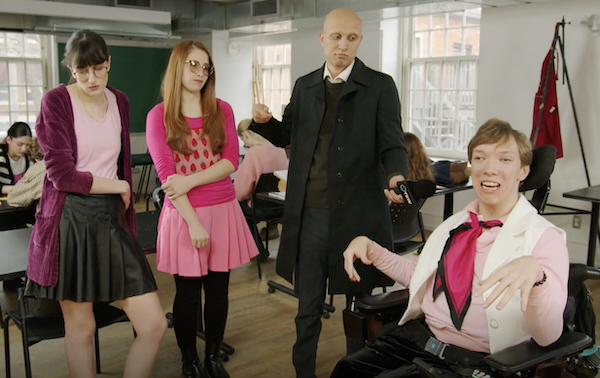
Laughter, this strain of disabled satire suggests, is a form of survival, and can be an act of political refusal against a culture that expects disabled people to smile placidly and expect less — from their families, from their workplaces, from their healthcare providers, and from their governments. Permeating The Squeaky Wheel’s strongest gags is a sense that for all their much-prided resilience, disabled people know they are not the elect of their respective societies, and have to fight for their rights. Out of that precariousness, the show’s troupe of disabled comedians and actors forge a community of embattled survivors, spinning absurdist satirical situations about the very real existential threats that face them.
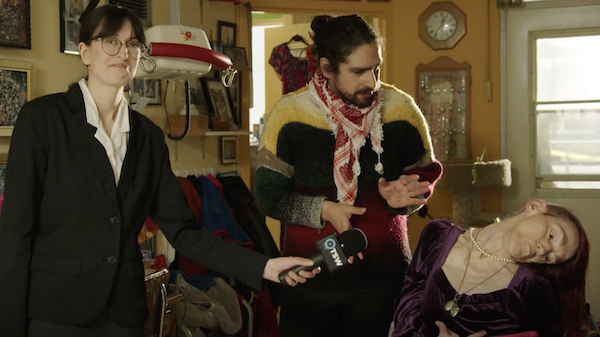
One of the strongest setpieces in this mold in the first six episodes features a farewell party for an impending MAiD recipient, an elderly disabled woman who deadpans that she’s not actually sick but has only applied for doctor-assisted dying because her rent’s been raised. Pressed to comment on her mother’s grim choice, her nondisabled children sheepishly confess that it’s for the best, since none of them want to take her in. The woman and her children’s respective punchlines collectively offer a striking, black-pilled rebuke to the myriad ways society encourages disabled adults to think of themselves as financial burdens for caregivers and taxpayers alike, with physician-assisted death cynically offered as an convenient solution to the problem of disability.
Another episode features a running gag where a reporter profiles the dating journey of a non-verbal wheelchair user (Anne Abbott) who’s had her chief communication device stolen on the train. She’s been forced to make do with a hand-me-down children’s tablet with buttons that correspond to pre-loaded phrases, their cheerful audio outbursts translating her ravenous adult desires into cryptic remarks about her love of meat and her cat, double entendres the woman’s smug nondisabled dating specialist assistant pretends not to understand. The bit skewers the worker’s all-too-familiar refusal to acknowledge the irrepressibly feral woman as a sexualized subject with her own agency, while also resonating for anyone who’s ever lost access to a prohibitively expensive accessibility device.
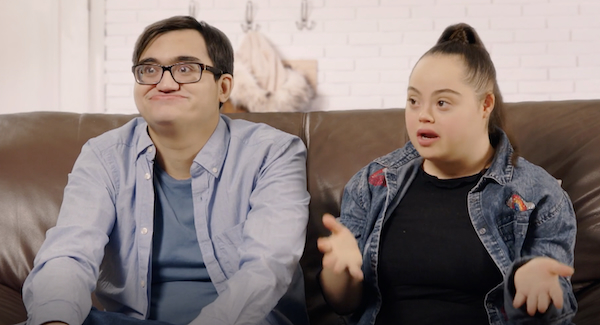
Absurdist scenarios like this one, as well as a segment where an intellectually disabled couple separates every 89 days to avoid losing the disability benefits that would be denied them if they were considered common-law spouses, can feel a bit like inside baseball for the uninitiated. But the fact that they’re impenetrable to anyone outside the community unfamiliar with, say, the byzantine funding structure of social assistance programs — and, paradoxically, immediately recognizable to anyone inside that community — feels more like a feature than a bug. It’s a recognition of the uniquely Kafkaesque bureaucratic dance of benefits-coordination that’s central to the lived experience of disability, a nightmare from which we never wake up, but which most of us have learned to navigate as in a lucid dream.
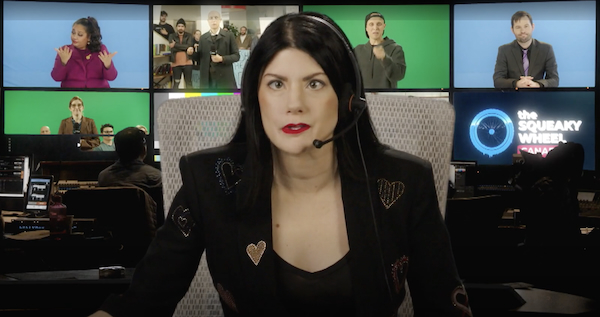
The Squeaky Wheel: Canada suffers from some expected first season jitters, from wordy or overextended bits to millennial cringe humour. It also struggles at times with an overly expository tone that borders on the sanctimonious — which is itself satirized, albeit inelegantly, by a recurring segment where Gilmour interrupts the broadcast in character as January Knougho from Organizational Operations Practices and Standards (or OOPS) to tell the anchors why their reporting is offensive. But it’s a pleasure to see such a variety of disabled artists embrace the rhetorical cudgel of satire to hit back at an ableist society that expects passive acceptance of austerity politics and eugenicist values. And for some disabled viewers, it may be the first time they see themselves — laughing at their nightmares.
Angelo Muredda is a Toronto-based teacher, film critic, and programmer. His writing on film has appeared in outlets such as Cinema Scope, The National Post, The Walrus, Now Magazine, SHARP Magazine, and Film Freak Central. He teaches in the Department of English at Humber College, where he is also Reviews Editor for the Humber Literary Review.