Mehdi Dandi at Stephen Bulger Gallery, Toronto
By Terence Dick
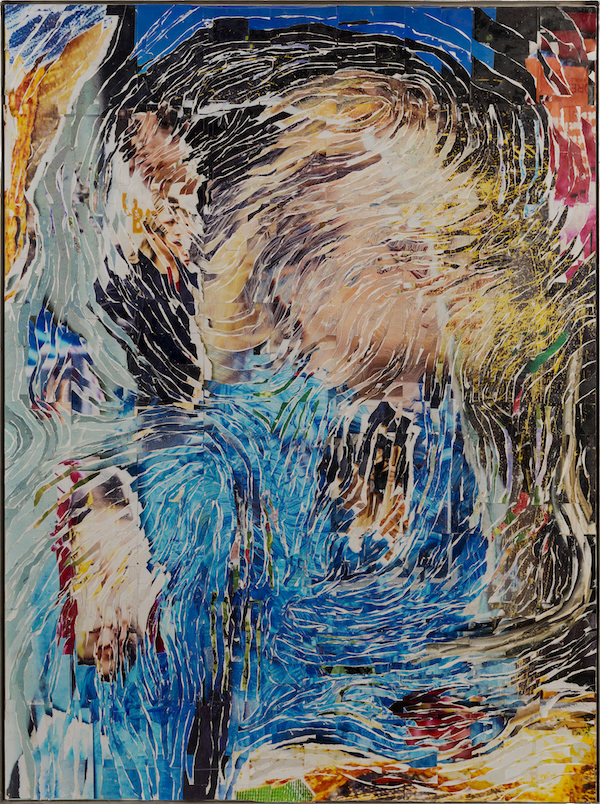
Mehdi Dandi, Chaos Secret, 2025, décollage of 1650 chromogenic prints (courtesy: Stephen Bulger Gallery)
Is unsettled art a salve for unsettled times or a symptom? Does it compound our anxieties or mitigate them? And what happens when things settle down? (As if that’s even a remote possibility.) These questions and many others rattled around in my head this week as I processed the new exhibition of Mehdi Dandi’s maximalist photo-collages at Stephen Bulger Gallery. One of the most pressing questions concerns whether it’s fair to interpret work made last year or earlier in the context of the past two weeks. It’s hard not to connect the Persian artist’s blasted portraits with the current war on the country where he was born – a war that threatens to destabilize what’s left of the global order. While that might be an immediate response to this complex and demanding collection, it’s neither the beginning nor the end of what the works purport.
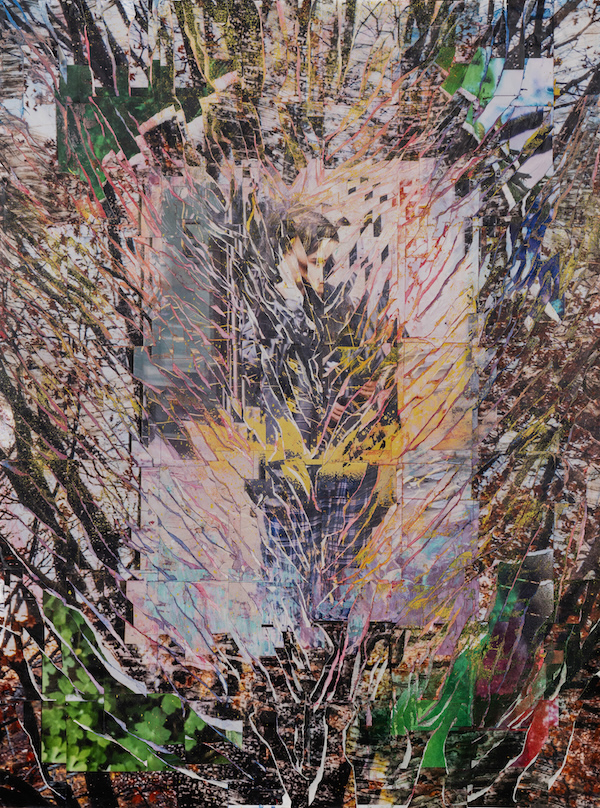
Mehdi Dandi, But You Said You’d Wait, 2024, décollage of 1100 chromogenic prints, acrylic paint (courtesy: Stephen Bulger Gallery)
Simply perceiving Dandi’s work is a challenge. His is an increasingly rare example of an artistic practice that does not translate well into digital reproduction. Checking out jpegs of his largely medium-scale photographs (for lack of a better term) does them a disservice, and even seeing them in the flesh requires more than a passing glance. From a distance they resemble abstract paintings held together by Van Gogh-like sworls or Jasper John’s loose grids. Within the noisome splatter of line, shape, and colour, figures, faces, and faint objects emerge only to dissolve on closer inspection. What at first seems like brush strokes is revealed to be torn photographs, layered in the hundreds, each slightly different than the other, to create a multitude of effects: motion, distortion, destruction, incipient creation. The conventionally smooth surface of a single print is disturbed by the raw edges of paper – the rarely displayed flesh of photography – that trace the dynamics of each composition with a subtly violent action to turn the works into sites of conflicting impulses.
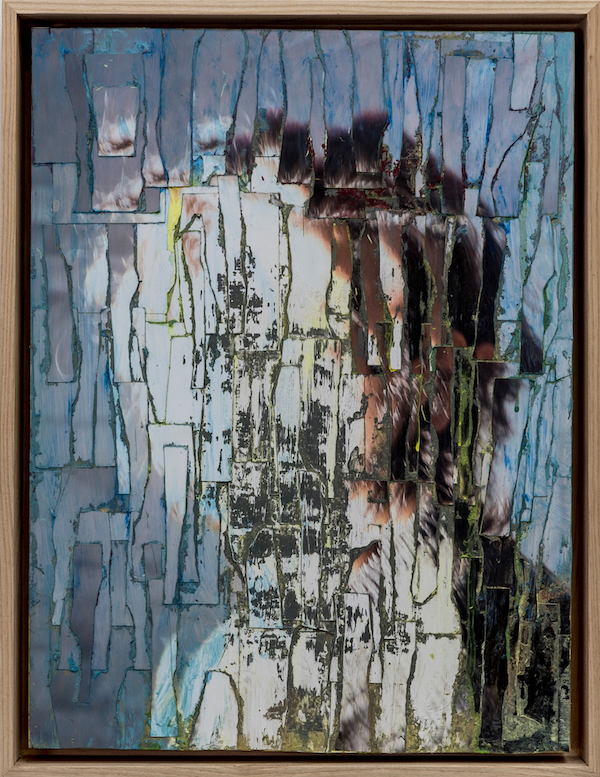
Mehdi Dandi, Self Portraits #4, 2024, décollage of 250 chromogenic prints, acrylic paint, spray paint (courtesy: Stephen Bulger Gallery)
Discerning the sources of the original images amidst the chaos of tears, profusion, fragmentation, and (if all that weren’t already enough) application of action-painted acrylic and spray paint is near impossible (and probably beside the point). A vitrine of small, single images – portraits of people on the street that have been impacted by a relatively slight (compared to the larger works) level of surface intervention on Dandi’s part – partially reveal what lies behind or within his more laborious constructions. They also help link his practice to artists like Sandra Brewster or Sarah Anne Johnson, who apply material effects on photography to pull it out of the realm of imagery into the world of objects, and in doing so conjure an approximation of the aura lost to mechanical reproduction while also liberating portraiture from the confines of realism through the cultivation of expressionism.
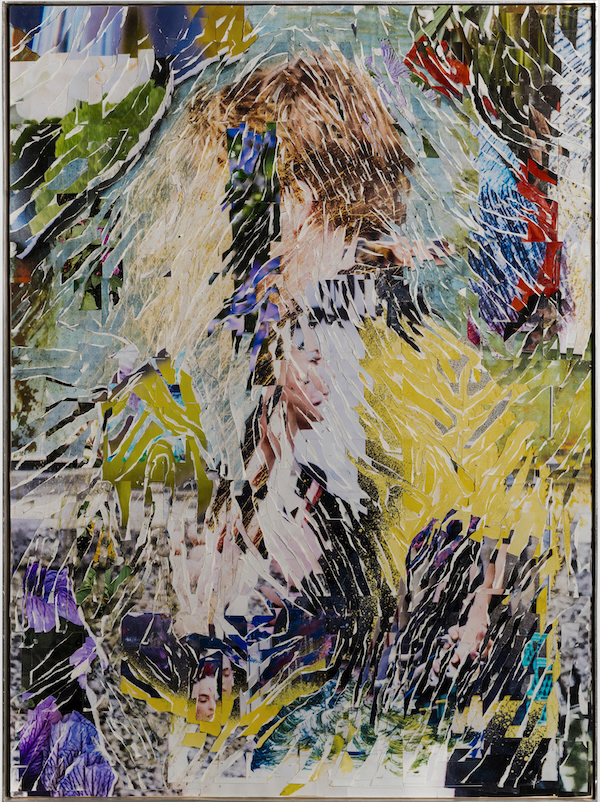
Mehdi Dandi, What I Saw That You Didn’t, 2024, décollage of 1200 chromogenic prints (courtesy: Stephen Bulger Gallery)
The question remains what to make of it. Where do the photographs end and the abstract paintings begin? What am I even looking at? Collage has long been a means to fuck with issues of origin. Using hands and knives to disintegrate one thing in order to assemble another is among the first lessons of making art as a modern child. Using scale and proximity to reveal the underlying components of what we see is as primal a perceptual impulse as putting your face to the surface of a television screen once was and as enlarging a jpeg until it pixelates is now. Reading a picture from the past in the context of the present is an inescapable reaction for those of us who live in the undeniable now. Were it not for my newsfeed, I might see Dandi’s art as a reflection of existential flux, an embrace of the elemental forces that dynamically define our state of being. I might see them as psychological portraits that hover on the precipice of dissolution, balanced between coherence and psychosis. I might also see them as explosive expressions of dense colour and intricate lines, and get lost in their vast array of surprising details. And, to be honest, I am guilty of doing all that because I have the privilege of keeping the world and the war temporarily at bay. But even that respite is unsettled, which makes this the most troubling exhibition I expect to see all year.
Mehdi Dandi: Afterimage continues until April 25.
Stephen Bulger Gallery: bulgergallery.com
The gallery is accessible.
Terence Dick is an arts writer living in Toronto. He is the editor of Akimblog.